
Understanding Fall Turf Nutrients: Nitrogen in Fertilizers
by Ann M. Mason, Fairfax Master Gardener and David Yost, Emeritus, Fairfax Master Gardener
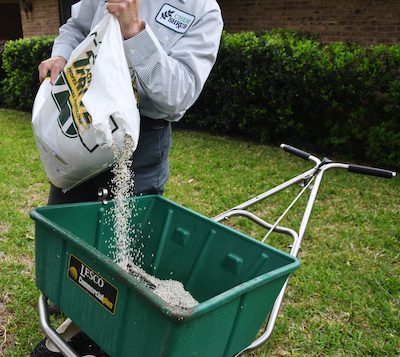 Fall is the best time of the year to fertilize cool season turfgrass (lawns). Cool season turfgrass include fine fescue, tall fescue, other fescues and Kentucky bluegrass.
Turf renovation starts with a soil test. But one element, nitrogen, is not measured in a soil test because it is soluble and leaches out of most soils. Nitrogen is important to turf because it is essential to protein synthesis and gives plants their green color; pale or yellow older leaves suggests insufficient nitrogen.
Nitrogen can move out of the soil quickly or slowly depending on the form of nitrogen applied to turf and the texture and mineral content of the soil. Why does the form of nitrogen matter to the gardener? Overapplication of quick-release or fast-acting nitrogen may cause nutrient runoff, damage the lawn and the gardener does not get the nutritional benefit to plantings. Use of slowly available nitrogen fertilizer reduces the risks of overapplication.
Many fertilizer bags will indicate a mixture of two or more forms of nitrogen. For both cool and warm season turf, Virginia Tech’s recommended the application rate is based on the percentage of slowly available nitrogen (water insoluble nitrogen or WIN) in the fertilizer. Some but not all fertilizer bags may identify the concentration of compounds that are Water Insoluble Nitrogen.
So, gardeners may ask the question, “How do I know if the fertilizer in the bag is fast or slow acting?” This article focuses on clarifying how to interpret the nitrogen component in the nutrient profile on a bag of fertilizer.
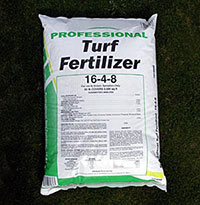
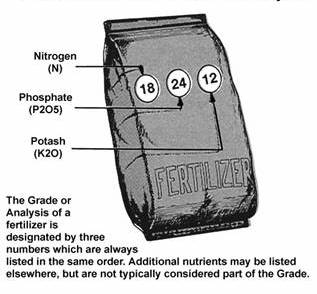 The nutrient profile is reported on fertilizer bags as three numbers with hyphens, such at 16-8-8. These numbers represent the concentrations (in percentages by weight relative to each other) of Nitrogen-Phosphorus-Potassium (K), N-P-K, in the fertilizer formulation.
Virginia Tech Soil Testing Laboratory results recommend the fertilizer ratio. Typically, fertilizer ratios it recommends are 1-1-1; 1,2,2; or 2-1-1, which allows the gardener to purchase a fertilizer having these ratios. For example, translating the ratio 2-1-1 means looking for a fertilizer that has two times the concentration of nitrogen compared to phosphorus and potassium, such as, 16-8-8, or 8-4-4. Virginia has banned the use of phosphate in lawn maintenance fertilizers, so 2-0-1 is a typical ratio for our area.
Gardeners might see a bag with the correct nutrient profile and assume the nitrogen component is the same in all fertilizers with the desired profile, 16-8-8, in our example. This is not the case.
With a closer look at the nitrogen component on fertilizer bags, gardeners will see names like nitrate, ammonium or urea. Some fertilizers might use the term rapid-release or slow-release nitrogen. While all nitrogen components contain nitrogen, oxygen, and are attached to a carbon compound, each type of nitrogen fertilizer functions differently.
Nitrate (-NO3–). A nitrate compound dissolves quickly in water and rapidly releases nitrogen to plant roots. Nitrate does not attach to organic matter in the soil, so it leaches quickly and runs off. Thus, there is a short period where plants can uptake nitrogen. Examples of nitrate compounds include ammonium nitrate and calcium nitrate. Nitrates can raise soil pH toward basic.
Ammonium (-NH4+), also called ammoniacal nitrogen. Ammonium compounds also dissolve quickly but these also bind to organic matter in soil and make part of the nitrogen less available to plant roots as well as less likely to leach. Application of ammonium compounds during plant low growth cycles (such as dormancy or in cool, dark growth conditions) may cause a buildup of ammonium in the soil leading to plant toxicity or the possibility of more acidic soil.
 Urea (CH4N2O). Urea is a slow-acting nitrogen source because it is a complex molecule that needs to be broken down into smaller components by soil organisms (microbes). Microbes serve as gatekeepers to the conversion depending on the soil’s temperature, moisture and pH. When soil is warm and moist, microbes convert urea in a series of steps first to ammonia, then to ammonium, then to nitrate. The benefits are a slower, more even nitrogen release over time. Depending on the microbe activity, some leaching, ammonium toxicity and soil acidity can occur. Examples of slow-acting nitrogen compounds include urea formaldehyde, methylene urea, sulfur coated urea, isobutylidene diurea and organic sources, such as bone meal, fish meal, dried blood and some animal manures. Note: high urea fertilizers, i.e., 46-0-0, should be handled carefully because they have a high potential to convert to ammonia quickly and burn plants.
For cool season grasses, Virginia Tech (VT) experts advise gardeners to limit the application of fertilizers with less than 15 percent water insoluble nitrogen to 0.7 lbs. per 1,000 square feet during active growing season; for fertilizers with 15 percent or more WIN, apply 0.9 lb. per 1,000 square feet. Never apply more than 1 lb. per 1,000 square feet of turf. The active growing season for cool season grass is September, October and November. In spring (May), VT suggests limiting fertilizers to approximately half the fall dose (0.5 lbs. per 1,000 square feet turf). No turf fertilization in June, July, or August. (VT recommends fertilizing warm season grasses (zoysia and Bermuda grass) in May and June—its active growing season.)
Thus, before fertilizing, the gardener should review the VT Soil Test Notes for the turfgrass type to determine the poundage to apply. Knowing the nitrogen terms can help to decipher what type of nitrogen form you have in the bag because some manufacturers do not use the term ‘Water Insoluble Nitrogen.’ Importantly, manufacturer application rates on the bag may be inconsistent with the best practices for our Mid-Atlantic yards and our concerns about runoff into the waters of Virginia and to the Chesapeake.
Final Words:
- Never apply fertilizers to turf when it is either dormant or slow-growing.
- When overseeding as part of renovating turf, do not apply a weed and feed fertilizer. The herbicide will kill new seedlings. Instead, use a plant starter fertilizer for the first of the three fall fertilizations for cool season turf.
- Leaving grass clippings on the lawn will degrade and release nutrients to the soil. University experts suggest that gardeners can reduce lawn fertilization by 25 percent by leaving grass clippings on the lawn.
- Virginia Tech experts recommend, “Fertilizers are best applied when grass is dry, followed by watering the lawn after fertilization to wash particles off the blades.”
- Applying fertilizers to hard or paved surfaces is a waste of money and can cause runoff. Sweeping fertilizers from hard surfaces into turf can overfertilize those areas. State fertilizer laws prohibit the use of fertilizers as a deicing agent for sidewalks and driveways.
- References
- Soil Test Note 17: Lawn Fertilization for Cool Season Grasses, Virginia Cooperative Extension Publication 452-717
- Soil Test Note 18: Lawn Fertilization for Warm Season Grasses, Virginia Cooperative Extension Publication 452-718