
Sweet Potato
by Bryan Kiser, Fairfax Master Gardener 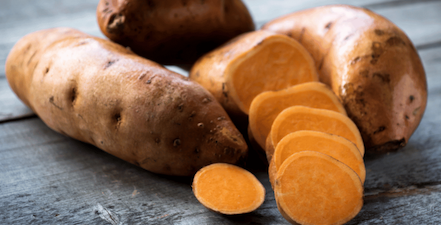 Many of us only enjoy sweet potatoes at Thanksgiving dinner, baked with butter, in casseroles topped with brown sugar and marshmallows, or in pies. However, they are a staple food source in several countries around the world. In 2019, global production of sweet potatoes was 89 million tons, led by China with 55 percent of the world total. Secondary producers were Malawi, Tanzania and Nigeria. It is the fifth most important food crop in developing countries. The sweet potato originated in South America in what is present-day Ecuador. In Central America, domesticated sweet potatoes were present at least 5,000 years ago, with the origin of Ipomoea batatas possibly between the Yucatán Peninsula of Mexico and the mouth of the Orinoco River in Venezuela.
Ipomoea batatas is a dicotyledonous vine in the morning glory family, Convolvulaceae, and is not related to yams in the order Dioscoreales. The starchy, sweet edible part of the sweet potato is a true root, called a storage root, not a tuber. The storage root will continue to get bigger as long as the plant continues to grow. Sweet potatoes are high in fiber and packed with vitamins, minerals and antioxidants. According to the 2026 Vegetable Crop Handbook for the Southeastern United States, there are a couple of varieties that work well in our area, Beauregard and Jewel. I have grown both, but prefer Jewel for production and flavor.
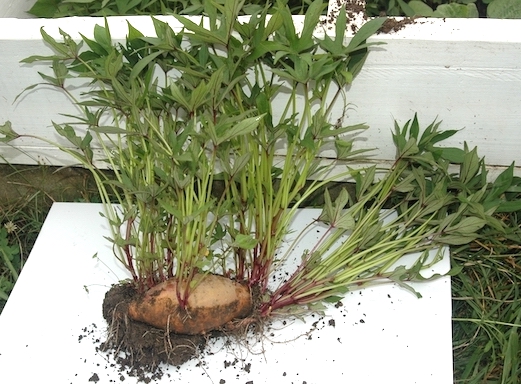
Sweet Potato Slips Propagation
Propagating sweet potatoes can be accomplished by seeds or slips (small cuttings from a growing plant). The best and most reliable method is to use slips. You can grow your own slips or purchase them from a reputable vendor. To grow your own slips, choose organically grown sweet potatoes, as store-bought ones are often chemically treated to prevent sprouting during storage. Cut the sweet potatoes in half and place the cut ends in either a jar of water or into moistened potting mix. Place the sweet potato starts in a warm, sunny location, or under grow lights. If using the water method, maintain water levels in the jar. For the potting mix method, keep the soil moist. Covering the starts with clear plastic will keep the soil from drying out too quickly. Once the slips have grown 5 to 6 inches (12-15 cm) tall and have several green leaves and some roots, “slip” the sprout with roots off the tuber by twisting it. You can also remove the slips by slicing them off the tuber. This ensures that the roots remain attached. Start slips indoors about eight weeks before the last frost in your area.
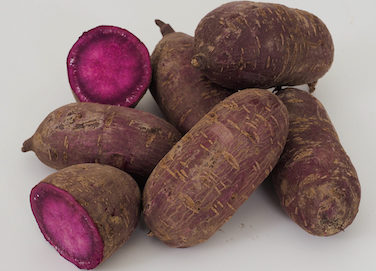
‘Purple Spendor’ Sweet Potato
Slips and vines are very tender plants that do not tolerate cold weather. Slips must be transplanted outside when the soil temperature is at least 65 degrees (18° C), which is usually in May or early June in our area. They require full sun and well-draining soil, rich in aged organic matter. Sandy loamy soil with a pH of 5.8 to 6.2 (slightly acidic) is preferred. Soil tests are recommended to guide any soil amendments. They require very little fertilization; too much can cause more foliage growth than root production. Most sources recommend planting them in 8- to 12-inch (20 to 30 cm) mounds, 18 to 24 inches (45 to 60 cm) apart in rows 3 feet (1 m) apart. The vines are space hogs and require lots of area to spread, so be careful where you place them in your garden. I have personally tried two planting methods, traditional rows and containers. I had reasonable production from both methods, but found the containers worked better for me. The containers I used were 24 inches (60 cm) in diameter and 24 inches deep. The potatoes grown in containers did not get as large as the row method, but were of good quality, and the containers helped reduce pest problems.
Sweet potatoes have numerous pest and disease problems. Pests include defoliators such as flea beetles, Sweetpotato Weevil, and Lepidoptera Larvae (e.g. army worms, horn worms, soy looper). They can be controlled by hand picking or Pest Management Guide recommended chemical means. The worst pest problem I have encountered is wireworms. They drill holes in the roots, and then rot sets in, destroying the root. One method to prevent wireworms is to avoid planting in land that was previously in sod or fallow. I have found that container planting can also reduce or even prevent wireworm problems. Disease problems include Black Rot, Fusarium Root Rot, Geotrichum Sour Rot, Rhizopus Soft Rot, Southern Blight and Scurf. The disease I have encountered most is Scurf; it is a fungal disease on the root surface. The injury is superficial, however, and does not affect eating quality. These soil-borne diseases are best controlled by using disease-free slips and a three-year rotation to crops other than sweet potatoes. Let the soil dry out between irrigations, as wet soil promotes root rot.
As previously mentioned, sweet potatoes are not cold-tolerant. It is important to harvest before a killing frost. Once there has been a hard frost and the tops are completely dead, the roots are at risk of rotting. You can begin harvesting when the roots are 5 to 6 inches (12 to 15 cm) in length and about 2 inches (5 cm) in diameter. Curing the sweet potatoes improves their quality and helps them keep longer. To cure, provide warmth at 80°F to 90°F (26º to 32º C) and high humidity for 7 to 14 days. Cure in a single layer with space between them for air circulation. When the skins are dry, the potatoes can be stored in a cool, dry location at 50°F to 60°F (10º to 15º C) for 3 to 4 months.
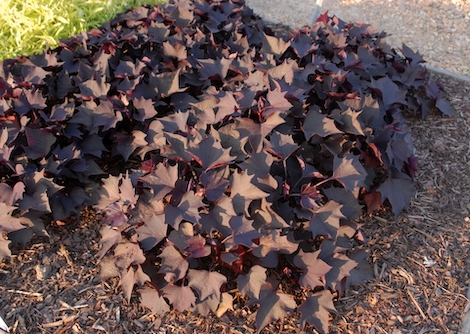
Ipomaea Sweet Caroline Purple
Ipomoea batatas, the sweet potato, is a good addition to any garden, good for you, and great-tasting.
Some people grow ornamental sweet potato vines. These plants differ from the edible variety. While they do produce edible sweet potato tubers (albeit not very palatable and bitter), the ornamental variety bears more colorful foliage, making it a popular houseplant. Ornamental sweet potato vines come in a wide range of colors and leaf shapes, including heart-shaped, three-lobed and maple-like leaves. Popular cultivars include Sweet Carolina Purple (dark purple foliage), Blackie (nearly black leaves), Marguerite (chartreuse green), and Tricolor (variegated green, pink, and white). Some varieties grow as long trailing vines up to 10 feet (3 m), suitable for trellises or ground cover, while bushier types are better suited for containers.
- Recipes
- Sweet Potatoes and Apples | Sweet Potato Salad, Virginia Cooperative Extension
- Sweet Potato Pie, The Pioneer Woman
- References
- Sweet Potatoes: How to Grow It, Robin Buterbaugh, South Dakota State University Extension Horticulture Field Specialist
- Sweet Potato Production, Lynn Brandenberger, Bizhen Hu, Eric Rebek, John Damicone, Oklahoma State University Extension
- Tips for Growing Sweet Potatoes, Washington State University Whatcom County Master Gardeners
- Fibermaxxing starts in the garden with these high fiber gardening tips from a produce expert, Devon Johnson, Virginia Cooperative Extension
- Ornamental Sweetpotato Ipomoea batatas, North Carolina State University Extension
- Sweet Potato Production and Pest Management in Georgia, University of Georgia Extension