
The Beauty and Basics of Yuccas
by Justine Frank, Fairfax Master Gardener Intern
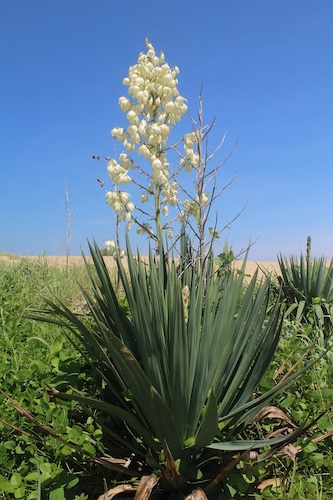
Yucca Gloriosa
Yuccas have a way of stopping you in your tracks. Their dramatic, upright leaves and sculptural forms bring a bold, almost architectural presence to gardens and indoor spaces alike. And while they’re famous for surviving tough, dry conditions in the wild, they’re also surprisingly adaptable in ordinary home landscapes. Understanding the environments they come from—and how they’ve evolved to handle them—sheds real light on why these plants behave the way they do.
“Yucca” refers to a group of roughly 40 to 50 perennial shrubs and trees native to North and Central America. The U.S. Department of Agriculture notes that many species inhabit deserts, prairies and coastal scrub, which helps explain their reputation for toughness.
Within the broader Asparagaceae family, yuccas hold their own niche. But even among yuccas, there’s variety. Some stay low and clumping, while others form tree‑like trunks over time. Gardeners often experiment with different species to play with height, silhouette and texture. Some common varieties include Yucca filamentosa (often called Adam’s needle), Yucca gloriosa and the iconic Yucca brevifolia, better known as the Joshua tree.
Yucca filamentosa or Adam’s needle is a broadleaf evergreen clumping shrub, 2 to 3 feet (60 to 100 cm) high, with erect dagger-like blue-green leaves. White yucca flowers occur in late spring to early summer. They are quite showy and add drama to the landscape. Flowers are on spikes that rise above the foliage. One variety, ‘Bright Edge,’ has bright gold margins on the leaves. ‘Color Guard’ has a leaf center with a cream-yellow color. ‘Golden Sword’ has a yellow stripe in the center.
Yucca gloriosa or Spanish dagger is a single-stemmed plant that is densely covered with sword-shaped, spine-tipped blue-green leaves. They originally appear as a mounded basal clump, but after several years the stem or trunk develops, typically growing to a mature height of 5 feet (1.5 m) and lifting the leaf clump off the ground. Creamy white, nodding, bell-shaped flowers appear in a dense, upright, terminal panicle in the summer. Cultivars include ‘Margueritaville TM’ with yellow-green vertical ‘Variegata’ with blue-green leaves and a wide gold margin.
Yucca brevifolia or the Joshua tree is a slow-growing evergreen, not a tree. It can be seen growing in the wild to a height of 15 to 30 feet (5 to 9 m) in full sun and in dry, coarse well-draining soil. Joshua Tree survives 150 to 300 years and is native to the Mojave Desert. Its spikes are covered in white bell-shaped flowers in late spring. Light green seedpods mature on the shrub in clusters. Joshua Tree is an important source of food and shelter for wildlife, Birds nest and perch on it.
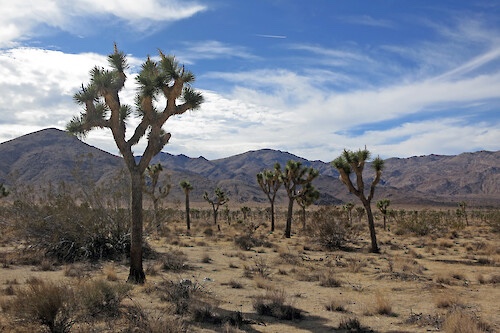
Joshua Trees (Yucca brevifolia)
Despite their range, most yuccas share a few signature traits: stiff, sword-like leaves, tall flowering spikes and the ability to store energy and moisture to help them weather long dry spells. In the garden, they often serve as accents—plants you place intentionally because of the way they draw the eye.
Yuccas aren’t just rugged ornamentals. They have well-documented ecological ties. The National Park Service highlights one of the most remarkable. Certain yucca species depend on the yucca moth for pollination, and the moth, in turn, depends on the yucca to reproduce. This mutual reliance is unusual in the plant world and underscores how deeply yuccas are connected to the ecosystems around them.
There’s also a long history of human use. Extension programs from several universities describe how indigenous communities used yucca fibers for basketry and rope, and processed the saponin-rich roots into soaps. That mix of utility and beauty is part of why the plant continues to fascinate gardeners today.
Thinking of yuccas as “desert plants” is helpful, but it’s even more accurate to think of them as specialists in bright, dry, airy environments. Indoors, yuccas thrive with abundant light. Several university horticulture departments emphasize that plants grown in dim spaces tend to stretch or lean. Placing a yucca near a bright south-facing window usually keeps it compact and sturdy. These plants are comfortable in warm, dry air. Some species tolerate freezing winters (such as Yucca filamentosa, while others need consistently frost-free climates. Indoors, average home temperatures suit them well, and they don’t require added humidity.
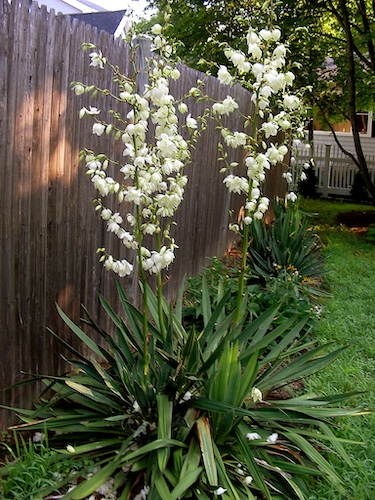
Yucca filamentosa in bloom
One of the surest ways to harm a yucca is to plant it in soil that stays wet. In their native habitats, the soils are sandy, rocky or fast-draining. A cactus mix or a potting soil, amended with sand or perlite, creates similar conditions in a pot. University extensions consistently warn against overwatering. Letting the soil dry significantly between waterings is usually best. A healthy yucca handles occasional drought far better than constant moisture.
Yuccas don’t demand heavy feeding. A diluted, balanced fertilizer applied a few times during the growing season is plenty. Maintenance is simple: remove spent leaves or cut back overly tall stems if needed. Wear gloves because the leaf tips can be sharp.
They’re generally pest resistant but can attract scale or mealybugs if kept in low light or overly moist conditions. Bright light and good airflow go a long way in preventing issues.
If you’re seeking a plant that makes a statement without requiring much pampering, a yucca is worth considering. Outdoors, it meshes beautifully with low-water landscapes. Indoors, it suits sunny rooms where other plants might struggle. The main caveat is the leaf shape. Homes with small children or pets may want to place yuccas strategically to avoid accidental bumps with those pointed tips.
What makes yuccas appealing is not only their resilience but also the clarity of their needs: lots of sunlight, sharply draining soil and a watering schedule that errs on the dry side. These are plants that reward restraint. When given the kind of environment they evolved in — bright, exposed, and airy — they become striking, architectural companions that hold their presence year round.
- References
- Yuccas, Yucca spp,, Alex Niemiera, Virginia Cooperative Extension (3010-1501NP)
- Yucca gloriosa, Spanish Dagger, Moundlily Yucca, University of Florida, IFAS Extension
- Yucca Factsheet, Clemson Extension Home and Garden Information Center
- Yucca brevifolia, Missouri Botanical Garden