
Salvia – That’s Easy
by Diane Keller, Fairfax Master Gardener
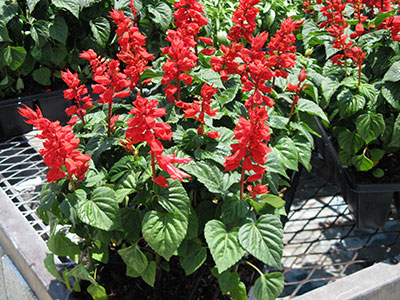
Red salvias (Salvia splendens)
Want to grow a beautiful plant with blue, purple, pink, red or white flowers? What would you think of bi-colored flowers? Do you want a plant that is easy to grow? How about a plant that will continue to bloom in the fall? Salvia is the answer. Salvia is a member of the Lammiaccae mint family that includes more than 1,000 species. This plant can grow from 6 to 8 inches (15 to 20 cm) tall all the way up to 6 to 8 feet (2 to 2.5 m) tall depending on the variety. Annual Salvias are warm season performers, but the perennial types will bloom year-round if they survive the winter weather. Salvias are loved by bees, butterflies and hummingbirds and are also deer resistant.
The species most associated with ornamental gardening include Salvia coccinea, commonly called Texas sage with red pink or peach flowers; Salvia farinacea or Mealy Cup sage with blue, purple or white flowers; Salvia patens or Gentian Sage with striking light blue flowers; and Salvia splendens or Mexican Sage with many colors.
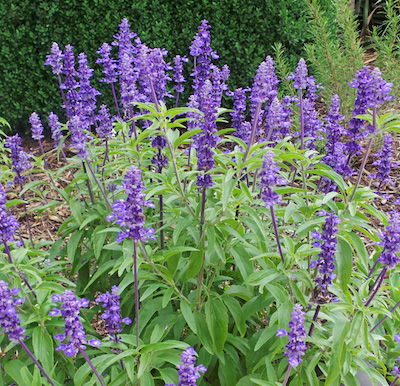
Salvia farinacea, Mealy Cup Sage
These plants thrive in very well-drained soil and plenty of sun. Salvia will do well in container gardening as long as the soil does not remain damp. Compost or sand can be amended into the soil to promote drainage. The soil for Salvia should register pH 6 to 7. Clip off old flower spikes to promote the growth of new flowers. If overgrown and not abundantly flowering, Salvia can be cut back in mid-summer and will regrow resulting in fresh foliage and flowers.
Because Salvia is prone to Powdery Mildew and root rot, it is very important not to overwater the plants. Spider Mites and Broad Mites can also be a problem with Salvia. Watering at the base and not on the leaves can help with this condition. Plant where Salvia gets at least 6 hours of sun, and space plants apart so there is constant airflow between the plants.
One of the best types of Salvia for autumn blooms is Salvia leucantha or Mexican Bush Sage. As the weather cools, the flower color deepens to a light lavender in color. Salvia elegans or Pineapple Sage is another great autumn bloomer. This Salvia has cardinal red flowers and is edible. Salvia greggi Mirage with a deep purple color blooms heavily in the fall.
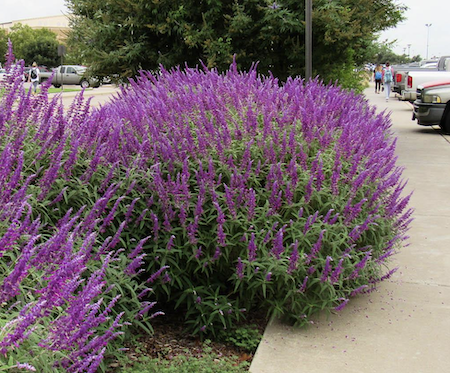
Salvia leucantha, Mexican brush sage
The species most commonly associated with cooking is Salvia officinalis, commonly called garden sage, common sage or culinary sage. Native to the Mediterranean region, sage is a perennial herb valued for its aromatic leaves and distinctive flavor.
Sage can be started from seed, cuttings or division. Although seeds can be used for starting sage, cuttings are often preferred because sage may germinate slowly or take a long time to produce. Once established, sage benefits from regular harvesting and pruning. Harvesting young stems encourages new growth and helps prevent the plant from becoming excessively woody. Leaves can be harvested throughout the growing season.
The culinary value of sage is the aromatic leaves. Sage has an earthy, robust flavor that can be quite intense when eaten raw, so it is commonly cooked with other ingredients. Sage’s bold flavor works well with strong- flavored meats such as beef roasts or lamb and starchy vegetables. It is especially well-known as an ingredient in poultry stuffing.
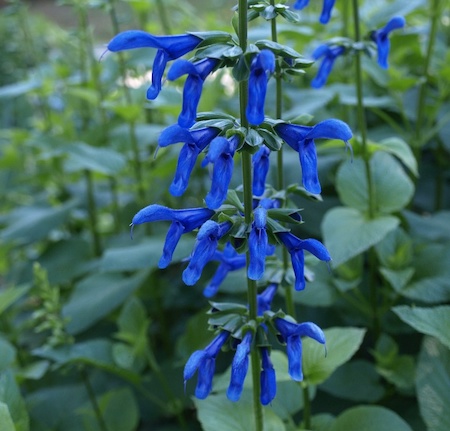
Black and Blue Salvia
Sage can be used either fresh or dried. Fresh leaves provide a stronger aroma, while dried sage has a more concentrated flavor and can be stored for extended periods. After sage reaches a mature leaf stage (6 to 8 inches long) pick the leaves for drying. Store the dried leaves in an airtight container away from heat and light. Sage can be enjoyed this way after the growing season and throughout the year.
In conclusion, Salvia officinalis is both a practical garden plant and a versatile culinary herb. Its Mediterranean origins explain its preference for sunlight, good drainage and relatively dry conditions. Gardeners can propagate it from seeds or, more reliably, from cuttings, while regular harvesting and pruning help keep the sage plant producing leaves. In the kitchen, sage’s distinctive earthy flavor makes it particularly useful with meats, stuffing, vegetables, pasta, beans, sauces, and butter. Its combination of being quite easy to grow, attractive foliage and culinary usefulness makes common sage a valuable addition to both home gardens and kitchens.
- Resources
- Sage, University of Maryland Extension
- Salvia officinalis, North Carolina State University Extension
- Sage, Salvia officinalis, University of Wisconsin–Madison Extension
- Sage: The Wisest Herb, Clemson University Extension
- Salvia, Gardening Solutions, University of Florida Extension