
Are Your Trees Stressed Out?
by Elaine Pugh, Fairfax Master Gardener
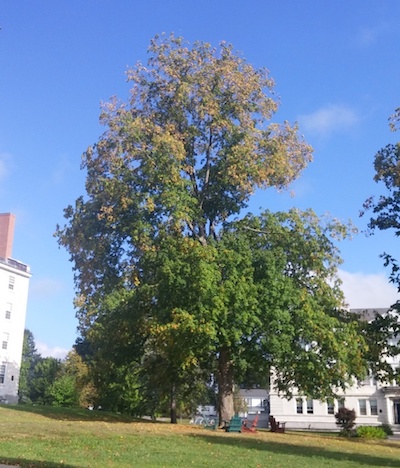
Drought stress with sparse smaller leaves at the top
We mow our lawns regularly and may take care of a garden, but we tend to think of our trees as self-sufficient. They’re not. A storm going through our area that suddenly topples trees and snaps branches is an obvious cause of stress to trees, but most stress factors are not as obvious.
What is “stress” in trees? The University of Minnesota defines it as an interruption or degradation of essential metabolic activities in a tree, resulting in reduced growth, reproduction and/or tolerance.
The University of Iowa states that when root systems are damaged, they cannot supply adequate water and nutrients for tree growth, so the tree may be unable to produce sufficient carbohydrates and growth regulating chemicals. When trunks or stems are damaged, the carbohydrates movement to where it is needed for growth and function is stopped, and may result in death of roots or other growing points of the tree. In other cases, the process of photosynthesis, the primary supply of carbohydrates for all tree functions, is reduced and the tree’s stored food reserves are depleted.
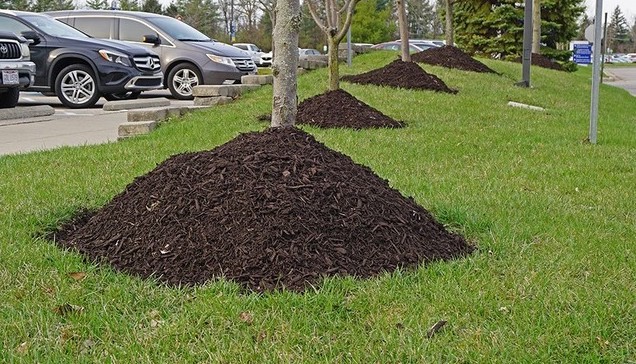
Volcanoes of excessive mulch
Most people think that insects and diseases are the biggest stresses for trees, but they’re not. Human activity is the number one reason for stress in a tree, and we don’t even realize it. Insects and diseases are commonly the result of a tree that has been weakened with the stress of other factors, so the tree is no longer able to defend itself against these additional stresses.
Diagnosing the specific source of stress to a tree is difficult because tree decline is rarely caused by one factor alone. And we don’t know if a particular stress factor is one-time, reoccurring or prolonged.
When you determine that a tree is stressed, try to identify the issues causing the stress, so a management plan can be developed to address the problem and get your tree back to health. For example, a slow and deep watering that mimics rainfall when sufficient rain is not forecasted can help many trees to recover if drought is the issue. However, the longer the stress has occurred without corrective measures, the harder it may be to correct.
A table from University of Maryland Extension shows the correlation between some of the tress symptoms a tree may show and possible related causes:
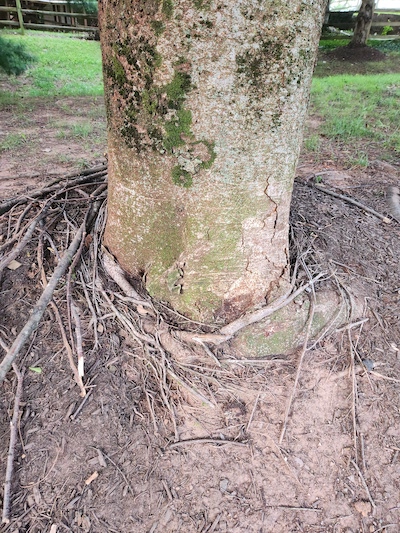
Root girdling
Bark rotting at the base of the tree can be caused by stresses such as being planted too deep, excess mulch and girdling roots. Bark cracking along the trunk can be caused by stresses such as being planted too deep, damaged roots, girdling roots, lower trunk damage, broken branches, winter plant damage, drought and excessive heat stress and lightning damage.
Leaf problems can be caused by stresses such as compacted soil, nutrient deficiency, soil pH problems, excess water or poor drainage, drought and excessive heat, salt or fertilizer damage and herbicide damage.
Branch dieback can be caused by stresses such as a grade change problem, girdling roots, lower trunk damage, broken branches, excess water or poor drainage, drought and excessive heat, or salt or fertilizer damage. Stunted poor growth and lack of establishment can be caused by stresses such as being planted too deep, compacted soil, excess mulch, excess water or poor drainage and drought and excessive heat. This can also be caused by embedded wires, nylon cord and wire baskets grown into the bark that were left over from planting.
Decline and eventual death can be caused by stresses such as being planted too deep, grade change problems, girdling roots, lower trunk damage, broken branches and excess water or poor drainage.
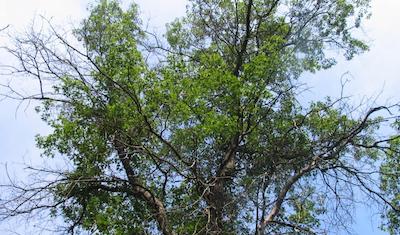
Oak Decline from several factors
What can we do to care for our trees? Prevention is the best medicine. The healthier the tree, the better it is to recover from a particular stress. The closer you can provide an environment that mimics the tree in its natural setting, the more successful its chance to grow and thrive. Provide the desired sun, water and soil requirements for that particular tree. For a new tree, the University of Massachusetts provides good, detailed instructions for the planting of a tree so you can give it a good start at its new home.
Provide ongoing routine care for your trees, such as watering, mulching, fertilizing and pruning and checking for symptoms of stress. Forest leaf litter can be mimicked by spreading 2-4 inches of mulch under the tree to cool the soil temperature. Regularly inspect your trees for any changes. Take a photo so you can compare it to last time you checked. Note any maintenance done recently to the turf and other areas around the tree that could contribute to any issues of stress.
When in doubt, call a licensed certified arborist to help. The more you can explain what you have analyzed, the more they can hopefully help you to return your tree to good health.
Trees are an important part of our landscape. They provide multiple benefits, such as aesthetics, multiple seasons of interest, cooling for our houses, a continuity of interest down the street, screening from neighbors, air quality, an economic benefit to increase property values and others. Keeping the trees healthy and as stress free as possible is a benefit to everyone.
- References
- What Causes Trees and Shrubs to Die?, University of Maryland Extension
- Troubled Trees, Nick Kuhn, Missouri Conservationist
- Helping Trees to Manage Stress, University of Massachusetts Amherst Extension
- Tree Injury and Stress, Iowa State University Extension and Outreach
- Stress Disorders of Trees, Urban Forestry Outreach & Research, University of Minnesota