
Mosquitoes in Our Midst
by Susan Stager, Fairfax Master Gardener
One downside of being outside in Northern Virginia and enjoying gardens is mosquito bites. More than an irritating pest, these insects have been called the world’s deadliest animal by the Centers for Disease Control, due to the diseases they transmit.
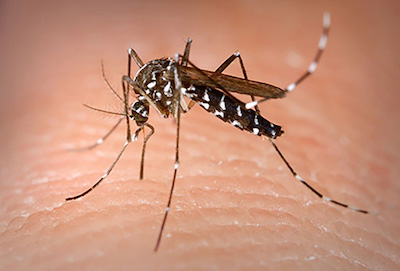
Asian tiger mosquito
Mosquitoes flourish in our warm, humid environment. If you are considering moving to get away from them, Alaska and Hawaii are unsuitable for mosquito survival due to Alaska’s long, harsh winters and Hawaii’s isolated ecosystem. Today, even Southern California is not exempt, now hosting two invasive (non-native) mosquito species, Aedes aegypti (yellow fever mosquito) and Aedes albopictus (Asian tiger mosquito). States with drier climates do have fewer mosquitoes, but not none.
Originating in South America, the Spanish explorers in the 1580s called mosquitos musketas, meaning “little gnat,” derived from the Latin “musca,” which means “fly.” The diminutive suffix “-ito” denotes smallness.
Mosquitoes have been found in amber fossils, which date back 125 million years. They are arthropods, which have a segmented body structure, an exoskeleton made of chitin, and jointed limbs. They also undergo metamorphosis, transitioning from larva to adult.
Adult females are the ones who bite and soon after lay their eggs, using the blood from the bite to help develop eggs and provide nutrition to the developing embryos. Male mosquitoes don’t bite and instead feed on nectar.
The vast majority of disease-transmitting and pest mosquitos belong to just a few key groups:
Aedes species mosquitoes spread dengue, Zika, chikungunya and yellow fever. Culex species mosquitoes transmit West Nile virus and St. Louis encelphalitis. Anopheles species mosquitoes (A. freeborni and A. quadrimaculatus) transmit malaria.
Two hundred types of mosquitoes inhabit the continental United States and U.S. territories, with approximately 12 species capable of transmitting diseases. Forty species inhabit Virginia.
Fairfax County lists these locally-acquired mosquito-borne diseases:
- Eastern Equine Encephalitis
- Jamestown Canyon Virus
- La Crosse Encephalitis
- St. Louis Encephalitis
- West Nile Virus Infection
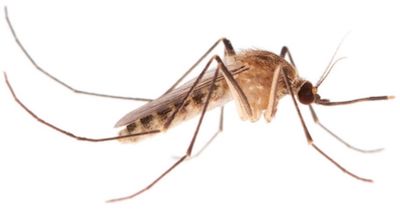
Northern house mosquito
At least five species transmit disease in Fairfax County. Asian tiger mosquito a day-biting nuisance mosquito common in urban areas of Virginia and a possible carrier of dengue, West Nile virus, chikungunya, LaCrosse encephalitis, Eastern equine encephalitis, St. Louis encephalitis and Zika virus. The Asian tiger mosquito first entered the United States in 1985, likely via used tires imported from Japan.
Asian rock pool mosquito (also known as Asian bush mosquito) is a possible carrier of dengue, West Nile virus, chikungunya, La Crosse encephalitis, Eastern equine encephalitis, St. Louis encephalitis and Zika virus.
Yellow fever mosquito is a subtropical mosquito found in some locations in Virginia and is a possible carrier of dengue and chikungunya.
Eastern treehole mosquito breeds in water-holding containers near houses and is a possible carrier of La Crosse encephalitis.
Northern house mosquito is a nuisance-biting mosquito and a possible carrier of St. Louis encephalitis.
Of particular concern are the Asian tiger mosquito and Asian rock pool mosquito (also known as Asian bush mosquito, both of which carry West Nile virus (WNV). Eighty percent of those exposed to West Nile virus display no symptoms. Over a 10-year period, 2015 to 2024, 30 cases have been reported to the Fairfax County Health Department, an average of three cases reported every year. Of these cases, 67 percent of patients had neuroinvasive disease and four died. The cases were geographically distributed throughout the county.
People 65 and older are three times as likely to develop neurologic illness from West Nile virus. Neither vaccine nor specific antiviral treatments for West Nile virus infection are available. In Fairfax County, West Nile virus poses the greatest risk. The County also lists occurrences of these travel-associated mosquito-borne diseases:
- Chikungunya
- Dengue Fever
- Malaria
- Oropouche Virus
- Yellow Fever
- Zika
Nuisance-biting mosquitoes in Fairfax that don’t transmit disease include:
- Flood-water mosquito (Aedes tivittatus)
- Vexans mosquito (Aedes vexans)
- Banded spring mosquito (Aedes canadsi)
The Fairfax County Health Department monitors throughout the county for mosquitoes. The Department uses a variety of mosquito and tick collection methods, including traps, as part of its monitoring activities. If you see a mosquito or tick trap, please do not disturb it. The traps will be labelled.
Prevent Breeding
Mosquitoes become full-grown in a week of warm conditions. What you do today to prevent their breeding will go a long way to making your outdoor experience more enjoyable in a week.
Remove sources of non-moving still water. Even several ounces, as much as in a soda bottle cap, can be enough for a breeding ground. Think where on your property there may be cans, buckets, gutters, water gardens, birdbaths, kiddie pools, tree holes, puddles, open rain barrels, flower pots and animal water dishes, and remove these sources or drain them twice a week if they need to be out. Regularly have your gutters and downspouts cleared to avoid build-up of backed-up water. If you cover items containing water to prevent mosquito access, know that sheets of plastic that can hold water after dew or after a rain, become breeding grounds themselves. Flush and refill bird baths weekly.
Doug Tallamy of the Homegrown Nature Preserve movement encourages the use of mosquito dunks. One or two buckets can be filled with water, leaves and grass clippings. Add one of these donut-shaped products that contain Bt israelensis, a larvicide, which is released in the water and kills the attracted larvae. Mosquito dunks are much more effective than electrocution devices known as “bug zappers,” which kill very few mosquitoes but many insects that are not pests. Mosquitoes are not attracted to ultraviolet light used by these zappers, but to warmth and carbon dioxide given off by animals.
Ultrasonic devices marketed as being able to repel mosquitoes have not worked as claimed in scientific trials. Mosquito spray services kill all insects, even the beneficial ones that help you out in your garden by feeding on pests. Bats do consume mosquitoes, up to 600 per hour, but mosquitoes are not a large part of their diet. A bat house would need to be installed properly to discourage bat predators (snakes and birds of prey).
Prevent Bites
Check your screens for holes. Stay indoors at dawn and early evening when mosquitoes are most active.
If you must be out, wear light colored clothing, with long sleeves, long pants, socks and closed-toed shoes.
When outdoors, use insect repellent containing either DEET, picaridin, IR 3535, 2-undecanone, or oil of lemon eucalyptus on skin or clothing. Always follow instructions on the product label. Insect repellents containing DEET have been used by the public in the United States since 1957.
Treat items, such as boots, pants, socks and tents, with permethrin or buy permethrin-treated clothing and gear. Permethrin-treated clothing will protect you after multiple washings. See product information to find out how long the protection will last. If you are treating items yourself, follow the product instructions. Do not use permethrin products directly on skin.
Once you’ve tried all these, you can submit a Fairfax County request form to inspect your home for mosquito activity and to show you what to address further.
Discouraging Mosquitoes
Fast-moving air can discourage mosquitoes. A large fan blowing on you while you garden can help discourage them. Mosquito nets hanging from your deck umbrella can also help give you relief as you observe your garden. Best practices for storing these are to bring them inside after each use, to avoid cats shredding them (they love the texture) and to avoid collecting water as the netting pools along the ground. These also prevent bees and spotted lanternflies from entering your peaceful space.
Some plants like marigolds, citronella and catnip, along with animals like frogs and bats, can each help somewhat to minimize mosquito activity. You’ll need more than one or two of these plants to be effective.
Latest Research
Virginia Tech researchers crossed Aedes aegypti, a major global arboviral (arthropod-borne viral) disease vector, and its sibling species, Aedes mascarensis, from the Indian Ocean. When offspring is crossed back with one parent, about 10 percent of the progeny becomes intersex and is unable to reproduce.
The researchers identified abnormalities in the sex determination pathways of these intersex mosquitoes. They found that these mosquitoes are genetic males but express both male and female genes, leading to mixed physical traits. By understanding these genetic factors, they hope to develop strategies to create all-male mosquito populations, which could help control mosquito numbers by eliminating females.
Where To Escape
You may blame your nearby pond, but mosquitoes are not found in the fast-moving water of streams, rivers or ponds. Here, the aquatic life eats the larvae. Mosquitoes also prefer shallow water to deep water. Your best escape would be a visit to the ocean, where you have both wind and moving water. A walk along the Potomac River might beckon, and remember you’ll need to walk through upland areas to get there.
- References
- Mosquito-Borne Diseases, Virginia Department of Health
- Mosquitoes and their Control, Theresa Dellinger, Eric Day, Sally Paulson and Dini Miller, Virginia Cooperative Extension
- First West Nile Positive Mosquito Pool 2025, Fairfax County Health Department
- Disease Carrying Insects Program Activities, Fairfax County Department of Health
- Mosquito Prevention, Fairfax County Department of Health