
The Universal Appeal of Cosmos
by Karen McCluskey, Fairfax Master Gardener
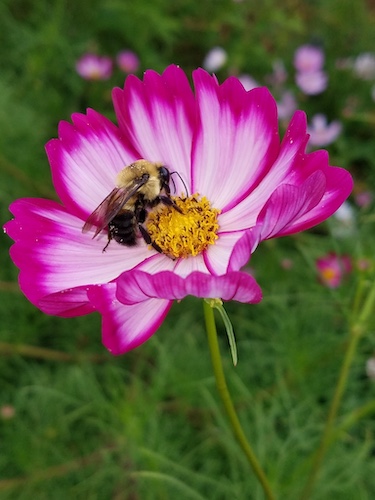
Bumblebee in Cosmos Flower
Cosmos are among the most popular annuals for home gardeners for a good reason. There’s a lot to like about them. They originated in Mexico and from Central and Tropical America. They are fast-growing, low-maintenance and produce tall, airy stems with showy, daisy-like flowers. Cosmos grow 12 inches (30 cm) tall or more, with some cultivars reaching 6 feet (2 m). They bloom from summer until the first frost and are available in a variety of vibrant colors. And if that isn’t enough, they support bees and butterflies, and can attract hummingbirds. The two common species are Cosmos bipinnatus and Cosmos sulphureus.
Let’s dig into how home gardeners can successfully grow Cosmos in Northern Virginia.
When choosing a cultivar, be sure to consider the potential height of the mature plant and how it will fit into your specific planting site. It’s always a good idea to carefully read the description and instructions on the seed packet. Taller cultivars, excellent for cutting gardens, may require staking depending on the planting location and wind conditions. Consider planting taller cultivars near fences or other structures to provide support for their tall size.

Cosmos Bipinnatus
Seeds can be directly sown outdoors in late spring, after the risk of frost has passed. This is typically mid-April in Northern Virginia, and once the soil has warmed to at least 65°F (18° C). Ideally, seeds should be planted in an area receiving six or more hours of direct sunlight, so place them away from the shade of trees or buildings. Cosmos can be planted in moist to dry soil conditions, and they even tolerate Northern Virginia’s clay soil. They are also suitable for container gardens.
Lightly rake the soil and scatter the seeds directly on the surface, then cover them with about one-eighth of an inch of loose soil. Keep the soil moist for five to 10 days after seeding in order to promote germination. Seeds will generally germinate in seven to 21 days.
While Cosmos tolerate dry conditions, it is beneficial to water them regularly, taking care not to overwater. Cosmos do not need fertilizer; in fact, fertilizing can reduce flower production. Flowering should begin two to three months from seeding. Deadheading, which is removing faded blooms, encourages more flowers and extends the blooming season.
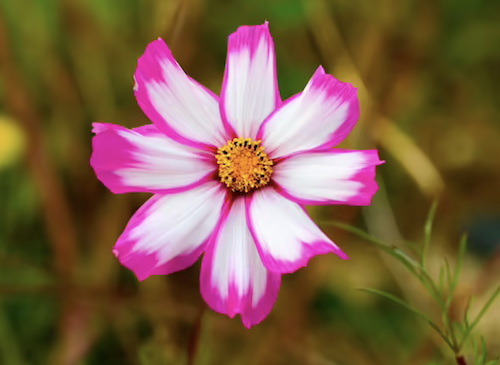
Cosmos Flower ‘Picotee’
If flower heads are left on the plant, they dry and drop seeds to the ground. These seeds can germinate and produce additional plants. To control their spread and placement, collect the dried seed pods and replant them where desired.
Aphids are occasional pests. The first line of defense is a strong spray of water. Powdery mildew can also be a problem. To reduce risk, space plants 1 to 3 feet apart to ensure adequate airflow.
Cosmos bipinnatus, (Cut Leaf Cosmos, Common Cosmos, Mexican Aster) has white, pink or maroon flowers. Here are a few popular cultivars and varieties, along with color descriptors:
- Candy Stripe’ has white flowers with red stripes along the length of the petals and edges.
- Daydream’ has pale pink flowers with darker pink towards the center.
- ‘Early Wonder’ has white or pink flowers.
- ‘Gloria’ has flowers with bright pink petals and a darker red center.
- ‘Picotee’ has white flowers with reddish-pink edges and light red lines running the length of the petals.
- ‘Versailles Tetra’ has deep red flowers with strong stems, making them ideal for cut flowers.
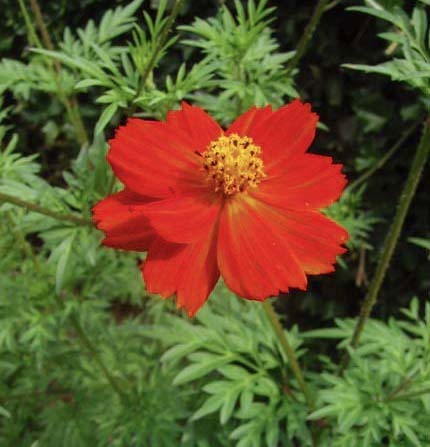
Cosmos sulphureus ‘Sunny Red’
Cosmos sulphureus (Klondike Cosmos or Sulfur Cosmos) produces yellow and orange flowers. Popular cultivars are described below. It’s worth noting that Cosmos sulphureus generally grows to a mature height of 1 and 2 feet, making it more compact than Cosmos bipinnatus.
- ‘Bright Lights’ has flowers with shades of bright yellow, orange, gold and scarlet-orange.
- ‘Lemon Twist’ has bright yellow flowers.
- ‘Sunny Gold’ has golden-yellow or orange flowers.
- ‘Sunny Red’ has fiery scarlet-red blooms with bright yellow centers.
Cosmos atrosanguineus (Chocolate Cosmos) displays a maroon or deep red flower and is a perennial, unlike the previous species mentioned. It is a native of Mexico, with a fragrance of chocolate and vanilla. It produces the same compound found in the vanilla bean. ‘Chocomocha’ and ‘Cherry Chocolate’ are the most common cultivars.

Cosmos atrosanguineus
It’s easy to understand why Cosmos are so popular with home gardeners. They fit into a multitude of garden styles, including: pollinator gardens, cutting gardens, cottage gardens and meadows. They provide a vibrant pop of color and are easy to grow and maintain.
If you are interested in viewing Cosmos flowers in a local public space, consider visiting Green Spring Gardens in Alexandria, Virginia. Peak display varies slightly by weather, but is usually late July through September.
Happy Growing!
- References
- Cosmos Brings Beauty to Your Universe, North Carolina State Extension
- Cosmos bipinnatus Growing Guide, Cornell University
- Cosmos sulphureus, North Carolina Extension Gardener Plant Toolbox
- Cosmos bipinnatus, North Carolina Extension Gardener Plant Toolbox