
Virginia Governor Signs Invasive Plant Species Bills
During the week of April 20 2026, Governor Abigail Spanberger signed four new bills into law to combat invasive plant species across Virginia and protect the state’s land, water, and wildlife.
 “Invasive plants are one of the most urgent and under-recognized threats to Virginia’s pollinators, songbirds, livestock, waterways, tree canopy, and recreational parks,” said Lauren Taylor, the executive director of the group Blue Ridge PRISM that helped draft three of the four new laws. “The scope and the scale of the problem are vast, and it will take a village to repair the damage done and ensure a healthy environment for future generations.”
The new laws aim to support long-term solutions that are more effective at prevention and species management. Specifically, they illegalize the planting of invasive species along state highways, expand the Noxious Weeds List, incentivize local jurisdictions to raise funds to control invasive species, and give state agencies the ability to use volunteers to control invasive species on state lands.
Invasive plants degrade habitats, reduce biodiversity and disrupt interconnected ecosystems. If invasive species get out of hand, they could reduce food production for farmers, poison watersheds, and alter landscapes for all species.
The bills were drafted with help from the Virginia Invasive Plant Coalition and Blue Ridge PRISM.
50th Celebration of FCMGA
by Pat Dickey, Fairfax Master Gardener
On March 17, 2026, Chairman McKay of the Fairfax County Board of Supervisors introduced a resolution to celebrate the 50th Anniversary of the Fairfax County Master Gardeners Association.
“The Fairfax County Board of Supervisors, on behalf of all residents, does hereby recognize and celebrate the 50th anniversary of the Fairfax County Master Gardeners Program, and expresses Its sincere appreciation to the volunteers, educators, and partners whose commitment has enriched the community for generations.”
Chairman McKay further stated that our group’s importance has never been higher than at this moment as we try to tackle so many of the environmental issues that our community sees. “They’re a cornerstone in so many ways as this resolution recognizes. In Richmond, legislation tries to deal with invasive species and plant sales, and sometimes many people ask why. Anyone who’s been in our woods and has seen what invasive species can do to our environment knows exactly why. It is important that groups like this are out there helping train people to do this and to do it in the right way. These are people who just stand up, and want to do their work to help our community, to help our residents to do their part to help our planet. Thank you for all of your work and dedication. I see Adria Bordas, who heads the Virginia Tech Extension Program, and a few of your staff who are here. Thank you for your work.”
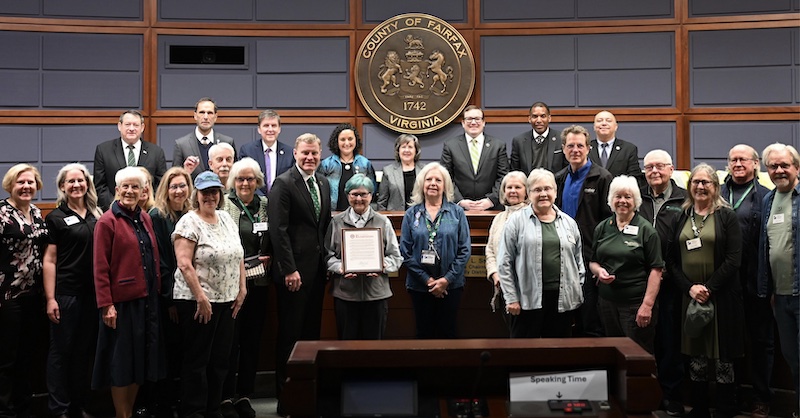 Our President, Susan McCrackin, thanked the members of the Fairfax County Board of Supervisors for this honor and appreciate the recognition. We are about 230 members strong who are dedicated to providing free, unbiased, research based horticultural information to our fellow Fairfax County residents. Certified master gardeners complete 99 hours of training and 72 hours of community service, and they are currently providing nearly 20,000 annual hours to the county, which results in substantial salary savings. We’re committed to volunteering in our community and to providing services that lead to resilient communities.
You will see us at farmer’s markets around the county, sharing our knowledge and advice to help our fellow county residents. We like to inspire 2,800 fourth grade students each year to grow their love of botany, and hopefully to spark an interest in growing plants. Master Gardeners help fight hunger in Fairfax County. With the support of volunteers, we have supported education gardens, at schools, community centers, and places of worship, with successful harvests of more than 11,000 pounds of food. Last growing season, we gave away hundreds of garden plants at Food For Others. We work for you. We appreciate the recognition of our work for the past 50 years and hope to continue this commitment for the next 50 years.
Chairman McKay also added that there is a therapeutic value of gardening for so many people. He has heard from people across the county that, during some of their toughest times, just going out into nature and gardening has brought therapeutic value to them.
Pest Alert: New Invasive Box Tree Moth
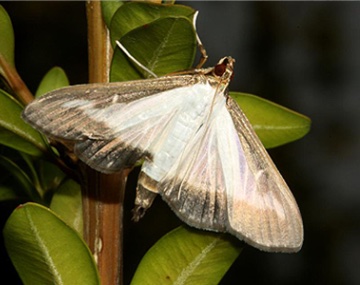
Adult Box Tree Moth
A new invasive pest has recently been detected in Virginia, the Box Tree Moth (Cydalima perspectalis). The Virginia Department pf Agriculture and Consumer Services reported that it was found at four sites in Clark and Loudoun counties. The Box Tree Moth can damage and kill boxwoods if left unchecked. Its caterpillars are ravenous feeders and can completely defoliate boxwoods with heavy infestations.
The Box Tree Moth is native to East Asia and has become a pest in Europe where the boxwood is native. In 2021, The United States Department of Agriculture’s (USDA) detected the Box Tree Moth in New York in 2021. It has been found in six more states since.
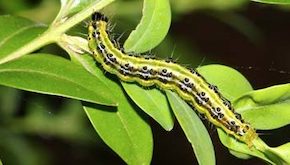
Box tree moth caterpillar
The adult moth has a wing span of approximately 1-3/4 inch (4 to 5 cm). Young BTM caterpillars strip the lower leaf tissue of boxwood leaves. As they mature, the caterpillars may remove all the leaf tissue except for the midrib of the leaves, which characteristically curls as it dries out. BTM caterpillars can quickly defoliate a hedge, and large populations resort to feeding on young twigs and bark when the foliage is gone.
Many different caterpillars have stripes on their bodies similar to those found on BTM larvae, but not many caterpillars feed on boxwood. Any green, black, yellow, and white striped caterpillars defoliating boxwood shrubs should be considered suspicious as possible BTM.
Virginia DACS will provide treatment if the Box Tree Moth is confirmed on boxwood plants. Report any suspected damage to boxwood plants on your property by Virginia DACS Invasive Species Reporting Tool.
Beech Leaf Disease Threatens Fairfax County Trees
by Pat Dickey, Fairfax Master Gardener
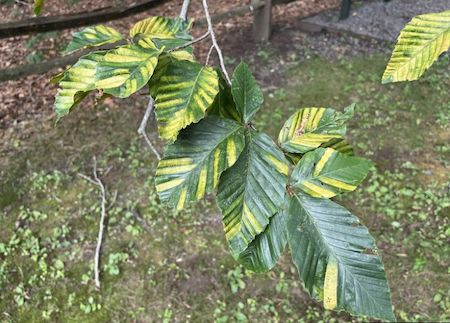 Our American Beech trees (Fagus grandifolia) are in danger of a new mysterious disease that has recently reached our parks in Fairfax County. A tiny roundworm (Litylenchus crenatae mccannii), a parasitic nematode, appears to be the culprit. Urban forest experts have been working together to determine how this nematode originally came to our country and what can be done to stop its infestation.
Beech Leaf Disease was first seen in Ohio back in 2012. Recently, in May 2022, traces of the disease were discovered in Burke Lake Park in Fairfax County. Since then, additional infestations have been found in Fountainhead Regional Park in Fairfax Station and in Hemlock Overlook Park near Clifton.
The big question is how did the nematodes come to Virginia while skipping neighboring states? Where did they originate? Right now, the thought is that the nematodes came from Asia by global commerce, on planes and ships. After they arrived, they probably were spread by wind and rain, or by insects and birds, or by all of these ways.
When the disease infests beech trees, it is easy to spot the dark bands along the veins of the leaves. You can see the disease by looking up through the tree’s canopy. The nematodes feast on the leaves and buds of the trees as a source of nutrients, and the leaves thicken and curl, turning brown and brittle.
There are around 4 million beech trees in Fairfax, and it would be devastating if they were lost to this disease. Luckily, the disease is fairly new here, and there is still time to solve its mysteries. Right now, there is no treatment to slow down the disease, but scientists are testing possible solutions. Scientists need our help in finding new areas in Fairfax where this disease has spread.
Use the app from iNaturalist to report any signs of beech leaf disease. Record observations and take several photos. Describe the area where the disease was seen so that others can determine the location.
Online webinar on Beech Leaf Disease.