
Pattypan and Crookneck — Summer Squash Beyond Zucchini
by Anthony Makara, Fairfax Master Gardener
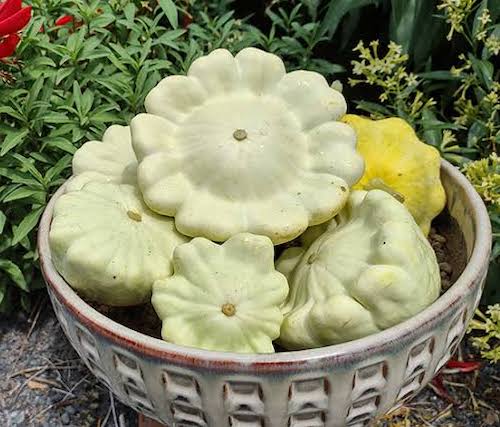
Pattypan Squash
It’s July and farmers’ markets have begun treating us to a dozen or so seasonal varieties of summer squash that present us an alternative to zucchini. They catch our eye with their unique shapes and warm colors, and the sure promise of tastiness. High on this list are two favorites, pattypan squash and crookneck squash, both of which also deserve a spot in our gardens and certainly on a dish at our summertime tables. Both have the common summer squash buttery and nutty flavors, and their distinct shapes and colors are a delight for the eye, not to mention the taste buds.
Pattypan and crookneck squash belong to the genus Cucurbita, which is native to North and South America for thousands of years. Mexico’s Oaxaca region and larger parts of Mesoamerica saw the domestication of many summer squash including crookneck and pattypan. Along with corn and beans, pattypan squash was a staple of the Indigenous People of America, and it was introduced to Europe only since the early 1700s. The French called it pâtisson, a scalloped cake mold, which eventually evolved to the English pattypan. Records indicate that crookneck squash was grown in the gardens of George Washington and Thomas Jefferson and appeared in seed catalogs in the early 1900s, along with many other squash. Besides their somewhat unique and entertaining shapes, they are a bit of a glimpse into history.
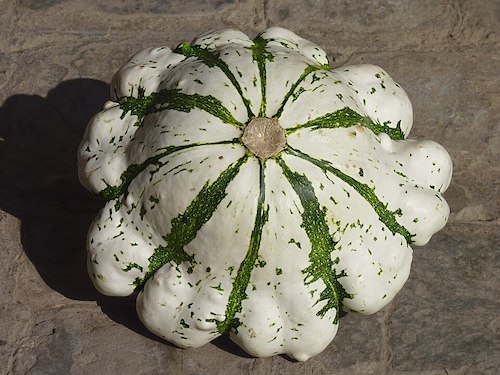
‘Jaune et Verte’ pattypan squash
Pattypan squash, Cucurbita pepo var. clypeata, also known as scallop squash, has a round flattened disc-like shape with a 4- to 5-inch (10 to 12 cm) diameter. Think of a tiny, flattened pumpkin. It has scalloped edges and shades of colors ranging from vibrant green, to pale or bright yellow, to white, or variegated combinations of green, white and yellow. It has been compared to a mini flying saucer and has also been dubbed the “edible oddity.” Popular varieties include ‘Early White Bush,’ ‘Golden Bush,’ ‘Jaune et Verte,’ ‘Peter Pan,’ and ‘Sunburst.’
Crookneck squash, Cucurbita pepo var. torticollis, has an appearance altogether different from pattypan, and different from straightneck varieties of squash, such as zucchini. With a bulb-like base, its narrower, elongated curved neck can be compared to a shepherd’s crook. Another comparison of its neck is to that of a swan. Yellow in color, the skin of most crookneck squash looks and feels a bit bumpy compared to the smoother skin of almost all other summer squash. Regardless, this bumpy skin is every bit as tender as its smooth-skinned cousins when harvested young. The Cornell University Extension lists a dozen or so varieties of crookneck squash. Among the more common are ‘Destiny II,’ ‘Dixie,’ ‘Early Summer,’ ‘Gentry,’ ‘Gold Star,’ ‘Golden Summer,’ ‘Supersett’ and ‘Sunglo.’ One in particular, ‘Zephyr Hybrid,’ has the distinction of both a yellow color and a base that looks as though it were dipped in pale green.
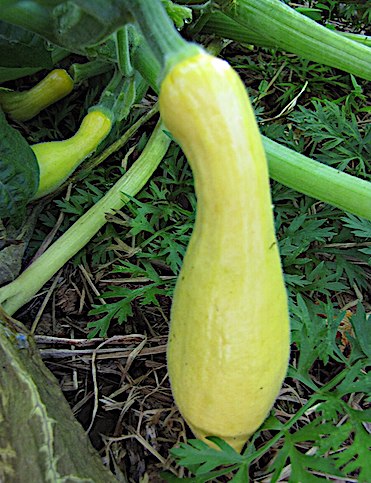
Crookneck squash
Pattypan and crookneck squash both have a slightly sweet, buttery taste that distinguishes them from the ever-plentiful and common green zucchini. Compared to crookneck squash, pattypan has a more firm, dense flesh which holds its shape while cooking. This makes it one of the best-suited summer squash for grilling or stuffing with cheese or grains. Contrasted with pattypan, crookneck squash has a slightly softer texture with a slightly higher water content that cooks down easily whether sauteed, roasted or as an ingredient in stir-fries, casseroles or soups. Each can also be eaten raw, sliced thinly as part of a salad, but the taste might be slightly bitter. The tender skin and seeds of both are touted to be the healthiest part. Flavorful and healthy, both deliver Vitamins A and C, and B-6, B-9 or folate, several antioxidants, calcium, iron and potassium.
Both the pattypan and crookneck squash plants are easy to grow. Virginia Tech categorizes these squash as “high value crops,” meaning that they are among those that bring the most value per square foot of garden. When planted in soil that is slightly loamy and well-drained, with six to eight hours of direct sunlight, they are remarkably fast-growing and productive. Start by planting three to four seeds in a six- to 12-inch (15 to 30 cm) mound of soil. Once the seeds germinate, keep the strongest looking plant and snip the rest. The plants of both pattypan and crookneck grow as a spreading bush with large leaves, maturing with a 3-foot spread (1 m) and about a 2-foot (0.5 m) height. Space limitations aside, if full sun is available, pattypan and crookneck will grow in a large container (minimum five gallons) that can be placed on a porch step, patio or balcony. Ensure that the container has sufficient drainage (e.g., a dozen or so half-inch holes) and fill with a soil lighter than if growing in the ground: a combination of light planting soil, compost and perlite.
Pollination is key to maximum production. When a squash plant matures, it produces yellow male and female flowers. Male flowers will appear first, with female flowers appearing a week or two later. The male flower will grow on a 3- to 4-inch (7 to 10 cm) stem, while the female flower has a small, embryonic fruit at the base of the flower. This is where the bees come in, as they get to work carrying the pollen from the male flowers to the female flower, where soon thereafter, the squash appears and begins its relatively rapid growth. Rainy weather may stall this process somewhat, since bees are usually inactive then. Planting flowers and pollinator plants close by will attract bees who will know to make a “beeline” to accomplish the squash pollination. That first young squash that we see means that the bee did its job. To protect bees and other pollinating insects, do not spray insecticides when they are present.
Both the pattypan and crookneck squash will take from 45 to 60 days from seedling emergence to produce their first squash. Thereafter, plants will produce up to four to six squash per week over an 8 to 12 week harvest period. As with summer squash in general, the fruits of the plant are best picked when young, when their rinds are tender and easily pierced with a fingernail. Besides having the best taste at this stage, picking regularly encourages the growth of new squash. As for size, a general rule is pattypan are at their best when about two to four inches in diameter, and crookneck squash should be no more than six inches in length. If not picked young, the squash gets too big, the skin toughens and there is diminished flavor and tenderness.
Because they are heavy feeders, beneficial soil nutrients and periodic fertilizing will produce the healthiest and most productive plants. Fertilizing should be done at planting time, when the plants start to blossom and again when they are regularly producing heavy fruit. Most in-ground plants do better with granular versus liquid fertilizer.
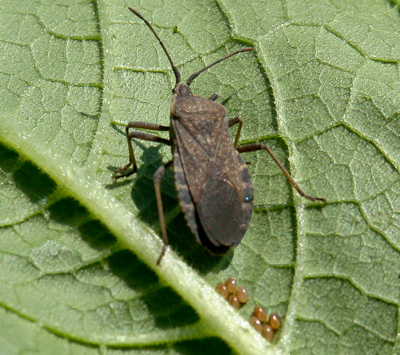
Squash bug with eggs
Squash plants have a huge thirst and once they begin producing they will need from 1 to 2 inches (2 to 5 cm) of water weekly from rainfall or hand watering. Try to water at soil level, with gentle slow application. Keep any water off of the leaves to lessen the chance of fungal disease. Soaker hoses or drip irrigation systems are ideal. Mulching around the base of the plant will help preserve soil moisture. Leaves will quickly show signs of mid-day stress on hot days, and will temporarily show signs of wilting, only to recover when sunlight intensity fades at the end of the day.
Once picked, pattypan and crookneck squash should be refrigerated. Keep them dry and unwashed until ready to use. Pattypan has a shelf life of three to five days, while crookneck is good for seven to 10 days. To freeze, wash and cut the squash into 1 ½ -inch (4 cm) slices. Bring about an inch of water (or enough to cover squash) to a boil. Add the squash and cook uncovered for three minutes. Remove from boiling water and cool. Pat dry and put cooled squash into freezer bags, leaving ½ inch headspace. Seal, label, date and freeze. Use frozen summer squash within eight to 12 months for best quality.
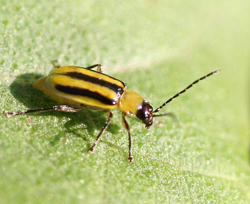
Striped cucumber beetle
No plant is immune from potential insect pests and diseases, and among those posing well-known risk to most summer squash are squash bugs, cucumber beetles and the squash vine borer. To mitigate extensive damage by the cucumber beetle or the squash bug, periodically check the bottom sides of the leaves for any small brown egg masses, and if noticed, just scrape them away, or use the sticky back of tape to lift them off the leaf and dispose.
Although chemical options are available, care must be exercised so that they don’t have an impact on needed pollinators. If pattypan and crookneck squash do fall victim to these pests, that can often mean the end of the plant. As disappointing as it may be, depending on the extent of the damage, the better alternative might be to pull up the plant, clean up the area and reach into that packet of remaining seeds to start another crop Remember, these plants grow fast, so just grow some more. During these “lazy, hazy, crazy days of summer,” reach for several of these squash from farm stands or grocery stores or pick up a packet of seeds at the garden center. Enjoy.
- Recipes
- Roasted Patty Pan Squash, West Virginia University, School of Medicine (426-406)
- Chilled Summer Squash Soup, World Cancer Research Fund
- Refreshing Summer Squash Salad, Allrecipes
- References
- Cucumbers, Melons and Squash, Diane Relf and Alan McDaniel, Virginia Cooperative Extension (426-406)
- Summer Squash, Michigan State University
- Cucumber, Squash, Melon and Other Curcurbit Insect Pests, Clemson University
- Pattypan Squash, Duke University
- From the Victory Garden: American History Told Through Squash, Smithsonian National Museum of American History