
Ground Nesting Bees
by Elaine Homstad, Fairfax Master Gardener
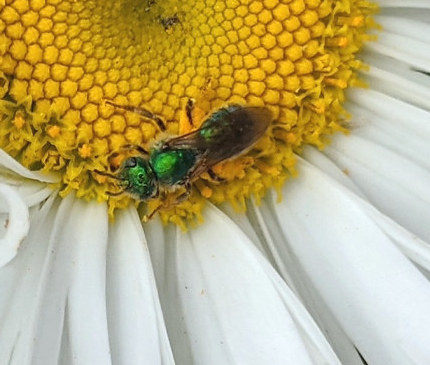
Mason bee on daisy
As gardeners, we appreciate pollinators, but did you know that many commercial agriculture sites use traveling hives of non-native honeybees to pollinate their crops? In our home gardens, our apian pollinators are mostly natives. With the hundreds of types of native bees, of all shapes and sizes, in our Mid-Atlantic region, about 70 percent are ground nesting bees.
According to the taxonomy of ground nesting bees, they fall into the Hymenoptera order. These are sorted by family, and within those categories, into genus and species. Our Mid-Atlantic region is home to nearly 500 distinct species of native bees. Their families are the following:
Anthophoridae — Carpenter Bees
Apidae – Bumble Bees
Andrenidae — Mining Bees
Halictidae — Sweat Bees
Megachilidae — Leafcutter Bees and Orchard Mason Bees
These native bees are mostly solitary, though within some species can be semi-social and clustered together, in individual nests. Some share nests and duties and have a queen. Some build their own nests, and others are opportunists, who commandeer previously used nests of bees or small rodents (chipmunks, voles, field mice).
Ground nesting bees are usually harmless. They tend to swarm low to the ground above their nesting sites, but this behavior is more defensive than aggressive. They will not deliberately try to sting, but if you trample them in bare feet, disturb their nesting spots during gardening chores or try to violently swat them away, you may inadvertently get stung. For this reason, you will want to keep any pets or children away from them for the four to six weeks when they are active. Because they are such valuable pollinators, you should resist the urge to remove them. However, if you feel you must manage their nesting habit for safety reasons, soaking the nesting area will deter the reproductive activities. Once there is no more activity, planting or mulching over it is the recommended solution.
 The time that ground nesting bees arrive in the spring is dependent on both weather and bloom times, but it is generally mid-March to early May in our area. However, many species have multiple broods per season, with the final one being in late summer as fall approaches. During their short life cycles, the new young bees appear from their nesting site, and the females dig (or find) a nest, mate, lay eggs and prepare a food supply for their developing offspring. Adults spend their time actively visiting plants to both feast on them and pollinate. The adults then die, and the complete process begins again. A good part of their life cycle is spent underground before appearing in the spring.
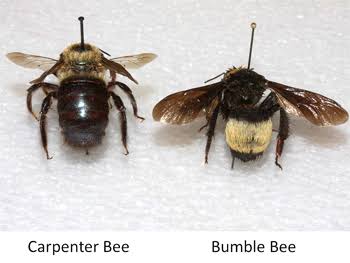
Carpenter Bees, Xylocopa virginica, can cause damage to wood structures, such as siding, fences, decks and porches by tunneling into them to lay their eggs. Although often mistaken for Bumble Bees, they are easy to recognize because they are large, about 1 inch (2 cm) long, and have smooth, rather than furred, abdomens.
Bumble Bees, Bombus spp., however, are large hairy bees with stout bodies and abdomens that are fully covered with hairs. Bumble Bees are particularly good pollinators for berries, peppers and tomatoes, popular crops for home gardeners. Providing early and long-blooming plant varieties can keep them coming to your garden. Many species collect pollen on their hind legs to bring back to their nests.
Mining Bees, Andrena, are the ones most often seen in yards and gardens. They are drawn to sunny, bare or sparsely covered patches of uncultivated ground in the lawn or garden. You can recognize their nests as a series of small holes, about the diameter of a pencil, with small mounds of dirt around them. These typically peaceful creatures can certainly help your landscape with their activity. They are active only for a few weeks during the year, when the females are excavating tunnels and creating underground cells for their offspring.
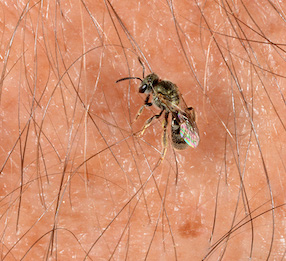
Sweat bee on skin
Sweat Bees, Halictid, are known for bright metallic coloration and their habit of collecting sweat for its salt. They can sting, especially when caught between clothes and sweaty skin. They are also beneficial pollinators.
Leafcutter Bees, Megachile spp., resemble small, dark, honey bees. They are solitary bees that cut small holes out of leaves to line the nesting cells for the immature bees. They can be a nuisance by making nests in doors and window frames.
Orchard Mason Bees, Osmia spp., are excellent pollinators for home gardens and orchards. They often use small cracks or holes in trees and appreciate bee boxes, either bought or constructed. They rarely sting, making them suitable for urban areas.
Sometimes another native, the Eastern Yellowjacket Wasp, Vespula, will also select abandoned rodent holes for their hives. The differences between them and bees are easily recognizable. Wasps are devoid of any fuzz on their bodies and have slim striped bodies with narrow waists. They are extremely aggressive and attracted to many non-plant items such as human food, dead animals, garbage and sweet liquids or aromas.
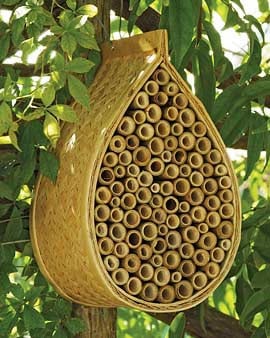
Man-made Mason bee house
If you have a spot where Nesting Bees would like to nest, you can create a habitat for them. Providing native plants and flowers can encourage them to visit, but it is helpful that about 80 percent of them are non-selective and will also choose non-native flowers. Adding a “puddling” spot or a flat rock for sunning can also attract butterflies to that area.
You may also see European Honey Bees in your garden. They also have calm behavior unless disturbed, like those natives in your garden. They nest in hives rather than in the ground and are attracted to many of the same native perennials, trees and shrubs as our native ground nesting bees.
Learning how to live with beneficial native bees can be a win/win situation for all. Please bee-lieve me and bee-friend bees!
- Resources
- Quick Background on the Mid-Atlantic Region’s Native Bees, Eastern Ecological Science Center, US Geological Survey
- Native and Solitary Bees in Virginia, Eric Day and Theresa Dellinger, Virginia Cooperative Extension (ENTO-151-NP)
- Mining Bees – Lawns, University of Maryland Extension
- Gardening for Bees, Plant NOVA Natives