
Five Poisonous Weeds May Be In Your Garden
By Ray Novitske, Fairfax Master Gardener
With past news about giant hogweed, we might think it was the only poisonous weed in our gardens. There are other sinister plants that can harm us if we touch them or if accidentally ingesting their poisons.
Poison Ivy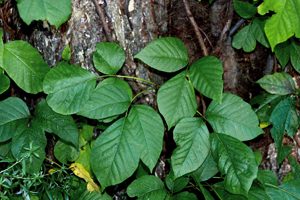 This vine (Toxicodendron radicans) from the sumac family, Anacardiaceae, is very common in our area and can be very dangerous. It grows in a wide variety of places but prefers damp, partial to full shady areas. The sap or oil from any part of the plant at any time of year (even winter) causes a severe allergic reaction in most people when it comes into contact with skin or other parts of the body. It is extremely dangerous if it gets into your eyes or lungs and respiratory tract.
Poison ivy, a perennial plant, has three leaves, with edges sometimes ragged and sometimes smooth. The lead leaf contains its own petiole or leaf stem, with the other two opposite leaves directly attached to the leaf stem. The plant usually grows along the ground but can be found climbing up the side of trees and fences. In the fall, the leaves usually turn brilliant red, orange or gold and drop.
The plant spreads after birds eat the berries and spread the seeds.
 Poison Hemlock
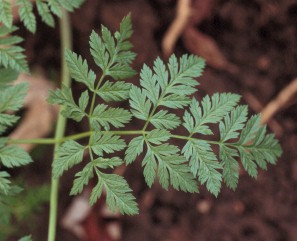
Conium maculatum is an invasive non-native, biennial, flowering plant in the carrot family (same as giant hogweed.) It grows 6 to 10 feet (2 to 3 m) in height with its green stems often spotted with red or purple. Leaves are lacy, fern-like and grow in small upright clusters. Flowers are clustered and white in color and develop into green deeply ridged fruit. The plant has a strange unpleasant odor.
All parts of the plant are extremely poisonous. The juice can cause skin irritation, but most poisoning occurs when people confuse the plant for wild parsnips or the leaves as parsley. The poison when ingested causes nausea, vomiting, coughing, tearing, salivation, sweating, weakness, dizziness, seizures, paralysis, coma and potentially death.
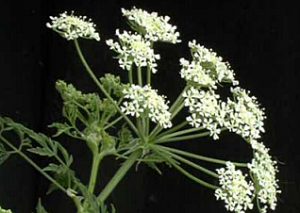 Distinguish it from other similar look-alike plants. Queen Anne’s lace smells like a carrot, while poison hemlock smells badly. Stems of wild carrots are hairy and green, while the hemlock’s stem is smooth with purple or red spots. Hemlock flower clusters are umbrella-shaped while Queen Anne’s lace is flat.
Horse Nettle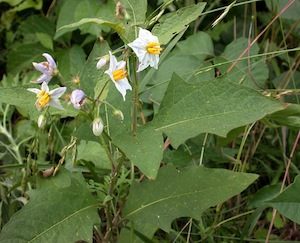 Solanum carolinense is a member of the nightshade family — the same as tomatoes and potatoes. It is a perennial native to the southeastern United States, but has spread to most temperate areas of the country. The plant usually grows up to a foot tall in our area, but can be taller. Leaves are 2 to 4 inches (5 to 10 cm) long, lobed, covered with fine hairs, and can smell like potatoes when crushed. Stems can develop prickers when mature.
Small star-shaped flowers are usually white with yellow centers and bloom throughout the summer. Fruit develops that is green with light stripes, maturing to yellow and wrinkled when mature. The plant grows in sunny areas, along roadsides, pastures and disturbed areas.
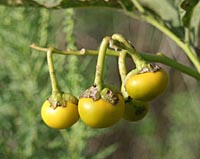 All parts of the plant are poisonous due to the chemical solanine. Most reports of human toxicity involve ingesting the fruits. They can cause nausea, diarrhea, stomach cramps and weakness. Horse nettle is rarely fatal, although children are more easily affected. Berries are more toxic than the leaves since the chemical is more concentrated there.
Pokeweed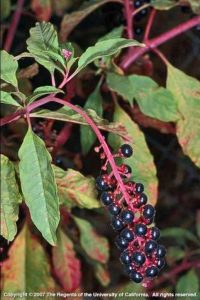 Phytolacca americana is a perennial that can grow up to 8 feet (2.5 m) tall. The stems are often hollow, with a red or purple tint. Leaves are oval with smooth edges, and are arranged alternate on the stems. Clusters of small white flowers lead to clusters of green berries that turn purple to black when mature. The purple juice of the berries gives the plant its name, which is derived from an Algonquin name meaning “plant with dye.”
All parts of the plants are poisonous and contain a plant chemical typically noted as a water-soluble foaming agent. In pokeweed, this particular compound is a poison. Contact with the juice from the plant should be avoided because it can be absorbed by the skin. The poison can cause nausea, vomiting, diarrhea, and interfere with respiration and pulse.
Like poison ivy, birds like the berries as food and spread seeds.
Water Hemlock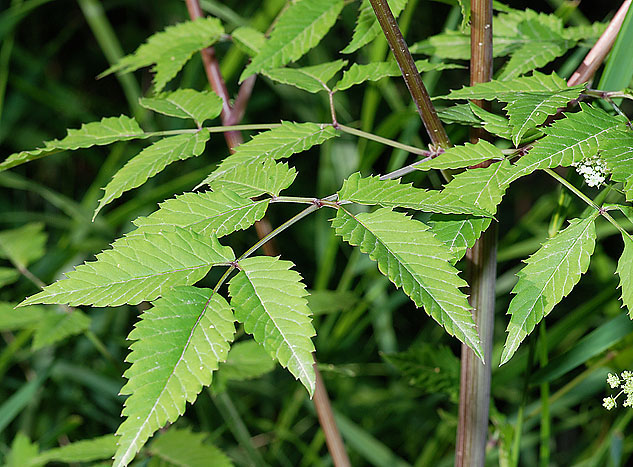 Not all native plants are good. Another member of the carrot family, our native water hemlock has the same effect as poison hemlock, although on a slightly less intense level. Its leaves are mostly solid, with serrated edges and leaf veining showing. The white flowers have five petals, and are clustered in groups to form an umbrella shape. They can bloom from early summer through the fall.
The perennial plant can grow up to 4 feet (1.2 m) in height, but usually grows to 3 feet (1 m) in height. It is found throughout the eastern United States, and prefers wet marshy sites in meadows, along streams and roads, and irrigation ditches.
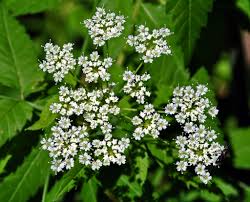
Water hemlock flowers
All parts of the plant are poisonous because of their neurotoxins that affect the muscles and the brain. Its poison is easily absorbed through mucous membranes and in the digestive tract. It can cause violent convulsions and respiratory failure leading to death. And yes, it affects animals, too.
All these plants can be found growing throughout our area. Hopefully this information will help you identify these plants and the potential dangers they pose. Armed with knowledge, you can protect yourself from Nature’s poisons.
…updated 2026
- Resources
- American Pokeweed, Weed Identification, Virginia Tech College of Agriculture and Life Sciences
- Horsenettle, Weed Identification, Virginia Tech College of Agriculture and Life Sciences
- Spotted Water Hemlock, Weed Identification, Virginia Tech College of Agriculture and Life Sciences
- The Socrates Project, Poisonous Plants in Virginia, University of Virginia
- Giant Hogweed, Identification and Control, Virginia Cooperative Extension (SPES-48NP)
- Eastern Poison Ivy, Weed Identification, Virginia Tech College of Agriculture and Life Sciences