
Three Native Edible Nut Trees of Virginia
by Justine Frank, Fairfax Master Gardener Intern
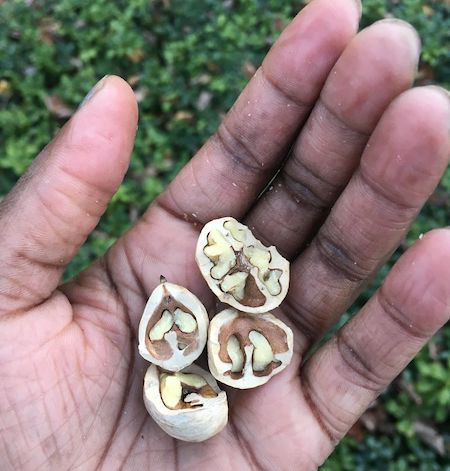
Hickory nuts
Virginia is home to several native nut-producing trees that may be suitable in your landscape. Besides the edible bounty we can take advantage of, they often sustain native wildlife. Birds and mammals find their nuts as an important fuel source in fall and winter.
Shagbark Hickory
If a tree could have a personality, shagbark hickory, Carya ovata, would probably be the eccentric old relative who refuses to dress conventionally but always brings something good to dinner. Its most recognizable feature is its bark, which develops into long, loose strips that curl away from the trunk, giving it its unmistakable shaggy appearance. It is a large, slow-growing, long-lived tree that can reach approximately 70 to 90 feet (20 to 30 m) tall and 50 to 70 feet (15 to 20 m) wide. That makes site selection especially important; a young nursery tree has a rather misleading way of making a future 90-foot tree (30 m) seem small.
Shagbark hickory prefers fertile, deep, well-drained soil and grows in sandy or clay loams. It tolerates acidic to neutral soil, full sun to part shade, and becomes drought tolerant once established. Its deep taproot makes established trees difficult to transplant, so choose the location carefully before planting. The nuts are sweet and edible and ripen in fall, but patience is required: North Carolina State Extension notes that a tree may take about 40 years to produce nuts. The species generally has few serious pest or disease problems, although hickory bark beetles, pecan weevils and twig girdlers can occasionally cause problems.
Black Walnut
Black walnut, Juglans nigra, is another large native tree, reaching roughly 50 to 90 feet tall with a broad crown. It prefers full sun and moist, fertile, well-drained soil, but tolerates clay, loam or sandy soils and a fairly broad pH range from acidic to slightly alkaline. It develops a deep taproot and is difficult to transplant, so again, the best time to think about its eventual size is before you put the shovel in the ground.
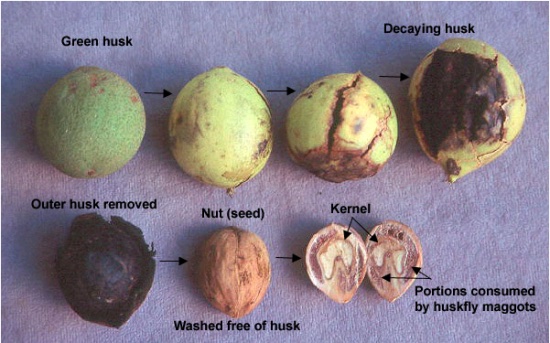
Walnuts
The nuts mature in fall inside yellow-green husks that can stain skin and clothing a remarkably determined shade of brown. The nuts are edible, but removing them from the husk and cracking the shell takes some work. A substantial crop generally takes many years, although nut production can begin earlier. Black walnut also deserves consideration when choosing its neighbors. Its leaves, stems and roots contain juglone, which NC State Extension identifies as capable of inhibiting some plants beneath the tree’s dripline. University of Maryland Extension cautions that the evidence connecting juglone to every instance of poor plant growth around black walnut is not conclusive, so it is more useful to research sensitive companion plants than to assume everything nearby is doomed.
Potential problems include anthracnose, bacterial blight, root rot, cankers, leaf spot, shoot dieback, aphids, fall webworm and foliage-feeding caterpillars. Thousand cankers disease is also a concern in some areas.
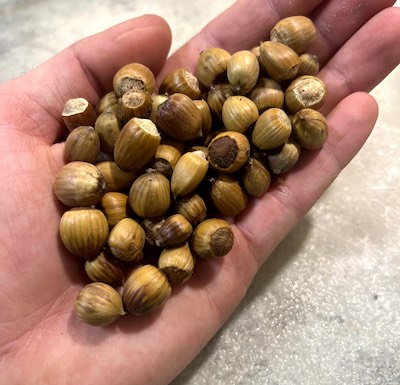
Hazelnuts
American Hazelnut
American hazelnut, Corylus americana, is the more manageable member of this trio. Rather than becoming a towering shade tree, it is a dense, multi-stemmed shrub that typically reaches about 9 to 12 (3 to 4 m) feet tall and 8 to 13 feet (2.5 to 4 m) wide. It grows in full sun to partial shade and adapts to clay, loam and sandy soils. It prefers good drainage and moist conditions but can tolerate occasional dryness. Its listed soil range includes acidic to neutral conditions. It is not salt tolerant, so a site immediately beside a heavily salted road or walkway is best avoided.
The nuts mature in late summer and are similar in flavor to European hazelnuts, although smaller. They can be roasted and eaten or ground into flour. American hazelnut is generally considered low-maintenance, with no serious pest or disease issues, although Japanese beetles, scale, leafhoppers and foliage-feeding caterpillars may occur. Leaf spots, blight and crown gall are occasional problems, and deer can cause moderate browsing damage. Of course, there is another potential problem with harvesting the nuts: squirrels and birds are already familiar with the menu.
Before You Buy and Plant
For all three species, start with the site rather than the plant. Virginia Cooperative Extension recommends choosing trees and shrubs suited to the site’s sunlight, soil, drainage and available space, and testing soil before planting. A soil test can determine pH and nutrient conditions and help identify whether amendments are actually needed. Drainage is equally important; VCE recommends testing a planting site before committing a tree to it.
When shopping, pay attention to the plant’s mature dimensions rather than its current nursery size. Shagbark hickory and black walnut need substantial room for their eventual canopies and root systems, while American hazelnut is much easier to fit into a residential landscape. Check for overhead and underground utilities and consider buildings, paths, gardens and neighboring plants. Virginia Extension also recommends planting trees in well-drained soil, digging a broad planting hole rather than a deep one, and positioning the top of the root ball at ground level or slightly above it.
These three native nut producers offer very different choices. Shagbark hickory is a long-term investment in a large landscape; black walnut offers edible nuts and valuable wood but requires thoughtful site and companion-plant selection; and American hazelnut provides an edible native shrub on a much more manageable scale. With the right plant in the right place, each can become a useful and distinctive part of a Virginia landscape. Just remember: the five-gallon version is only the beginning of the story.
- Recipes
- Best Candied Walnut Recipes 3 Ways, Kendall-Jackson Wine Estate
- Wild Hickory Nut Shortbread Cookies, Serious Eats
- References
- Carya ovata (Common Shagbark Hickory), North Carolina State University Extension
- Juglans nigra (Black Walnut), North Carolina State University Extension
- Corylus americana (American Filbert, American Hazelnut, Hazelnut), North Carolina State University Extension
- Tree and Shrub Planting Guidelines, Virginia Cooperative Extension (430-295)
- Walnut Toxicity — Juglone, University of Maryland Extension