
Colocasia and Alocasia – Best Tropical Buds
by Bryan Kiser, Fairfax Master Gardener
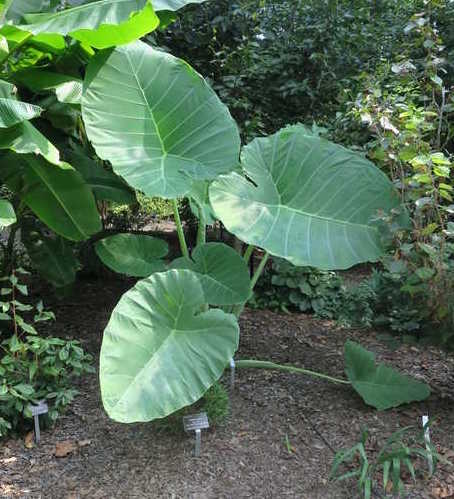
Colocasia gigantea ‘Laosy Giant’
Colocasia and Alocasia are tropical herbaceous species in the arum or aroid family (Araceae) and are better known by their common name, Elephant Ears. Elephant Ears are grown mostly as landscape ornamental plants because of their large ornate leaves. But they are also one of the oldest cultivated crops in the world, having been grown as a food crop in tropical Asia for more than 10,000 years. All parts of the plant are poisonous, while raw, but once cooked the tubers and leaves are edible. The edible varieties are still grown in the South Pacific and eaten like potatoes and known as taro, eddoe and dasheen. The leaves are often boiled with coconut milk to make a soup. Poi, a Hawaiian dish, is made by boiling the starchy underground stem of the plant, then mashing it into a paste.
Elephant Ears thrive in rich, moisture-retentive soil. Many selections grow well in soggy soil, and some species may form dense thickets. I have grown them as an aquatic plant in my pond. Most varieties grow best in filtered sun to partial shade, but the darker-leafed varieties do better in full sun. Both genera prefer a pH that ranges from 5.5 to 6.5. Elephant Ears are heavy feeders. They thrive with balanced fertilizers with a 20-20-20 ratio in liquid form, which should either be diluted to half-strength and applied monthly or added bi-monthly. The other alternative is using a slow-release form of fertilizer every six weeks to two months. They also require copious amounts of water and do best if the soil is not completely dry.
Although Elephant Ears can be grown from seed, they are better propagated by dividing their corms and placing them in large 1-gallon pots with rich, peat-growing media and applying consistent moisture. They are best started indoors, by potting up the bulbs in March and placing the top of the bulbs close to the soil surface. Keep the bulbs in a warm location until they are planted outside when the weather warms up, usually in late May or early June.
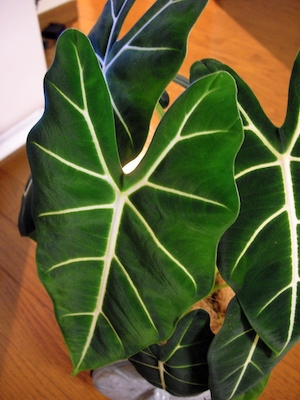
Alocasia ‘Green Velvet’
Both Colocasia and Alocasia are tender perennials that cannot survive winter months in many places. In USDA Zones outside of 8 to 12, you should either use this plant as an annual or dig up the tuber after the first frost and overwinter it in a cool, dry area (possibly in dry wood shavings or peat) where the temperature does not fall below 45°F (7°C). The tuber should then be planted again in late April. Possibly, an easier method is to treat them as a container plant and move the container inside during the winter, given that you have space for such a large container.
Colocasia and Alocasia are both referred to as Elephant Ears, but they have one very noticeable difference, their growth habit. Colocasia leaves are held on the end of long, thick, succulent petioles coming directly from the underground corm. The petiole attaches near the center of the lower surface of the leaf (peltate), and the leaves are held perpendicular to the upright petiole with the leaves facing upward or outward. The leaves of Alocasia are usually not peltate and are held more upright. In other words, the Colocasia leaves point downward, and the Alocasia leaves point upward. Colocasia is also considered invasive along the coastline of the Gulf States.
Elephant Ears have very few pests or disease concerns. Spider mites and mealy bugs may be a nuisance to some species. Root rot may occur from overwatering. They are generally maintenance-free plants, with the exceptions of feeding and watering consistently.
With their large, lush and irregularly-shaped leaves, Elephant Ears lend a cool, tropical feel to any landscape. The pointed tips, rippled edges and interplay of light and shadow across the foliage create a bold, coarse texture. For a pleasing contrast, pair it with softer, mounding plants that have small leaves, or with fine-bladed grasses. Companion plants with yellow-green, variegated or burgundy leaves will accentuate the deep green of the Elephant Ears, while flowers in white or warm shades like pink, soft yellow and coral provide a beautiful pop of color. Add them to large aquatic containers in combination with papyrus and water lilies or keep them in individual containers to mix and match with other plants on a deck or patio.
The following are some recommended cultivars:
- ‘Black Magic’ was the first black cultivar introduced. It has dusty purple-black leaves (with green undertones in shady conditions), the blades slightly folded upwards and dark petioles. It grows 3 to 6 feet tall and wide.
- ‘Blue Hawaii’ (Colocasia esculenta) is in the ROYAL HAWAIIAN® Series. It has medium green leaves with dark purple-black veins and maroon undersides. It grows 5 feet (1.5 m) tall when mature.
- ‘Burgundy Stem’ is a tall cultivar with deep purple petioles topped with big green leaves with a slight purple tinge.
- ‘Coal Miner’ is similar to ‘Illustris’ but is much earlier, does not spread underground as vigorously, the background leaf color is darker and the leaves have a velvety patina when they first emerge.
- ‘Coffee Cups’ (sometimes incorrectly called ‘Tea Cups’) is a vigorous hybrid with smaller leaves on very tall dark petioles with the blades folded upward to form a cup shape.
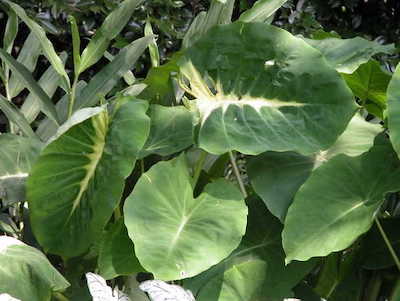
Colocasia ‘Nancy’s Revenge’
- ‘Nancy’s Revenge’ has color changing leaves that start out all green, then develop butter- yellow centers at the onset of flowering. The color leaks from the center down the main vein into the surrounding blade to eventually form an oval shape.
- ‘Pink China’ has green leaves on pinkish stems. It is one of the hardiest Elephant Ears, surviving in Zone 6b and further north in protected sites.
- ‘Stingray’ is an Alocasia with a distinct tail on the end of the leaf, giving it the appearance of a stingray.
- ‘Thailand Giant Strain’ is a mammoth selection of Colocasia gigantea with blue-gray-green leaves up to 5 feet long and 4 feet wide on a plant over 9 feet tall under ideal conditions.
- ‘Yellow Splash’ is a yellow and green variegated type, heavily splashed with creamy yellow patterns.
- ‘Fontanesii’ (violet-stemmed taro) is a tall hybrid with dark green leaves with a shiny black cast on dark petioles.
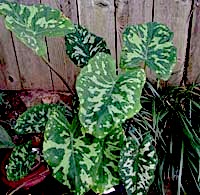
Alocasia ‘Hilo Beauty’
- ‘Hilo Beauty’ is a small variety (about a foot tall) of Alocasia with irregular yellow or cream flecks on the dark green leaves.
- ‘Illustris’ (Colocasia esculenta, Imperial taro, var. antiquorum) has dark green matte leaves with a purple to black luster and bright green veins and petioles. The plants spread by underground runners. Color is more intense in bright light, but the leaves are never as dark as ‘Black Magic’ or many other black varieties.
- ‘Jet Black Wonder’ has light-colored veins on a black background.
- References
- Elephant Ears (Colocasia, Alocasia, and Xanthosoma), Susan Mahr, University of Wisconsin – Madison, Division of Extension
- Colocasia, North Carolina Extension Gardener Plant Toolbox
- Colocasia, University of Illinois Urbana — Champaign, Illinois Extension Plants
- Alocasia macrorrhizos-A Plant of Giant Nature!, Michelle Krespi, University of California, Agriculture and Natural Resources
- Fun with Elephant Ears in the Garden, Barbara H. Smith, Clemson Cooperative Extension