
Fall and Winter Veggie Woes
by Bryan Kiser, Fairfax Master Gardener
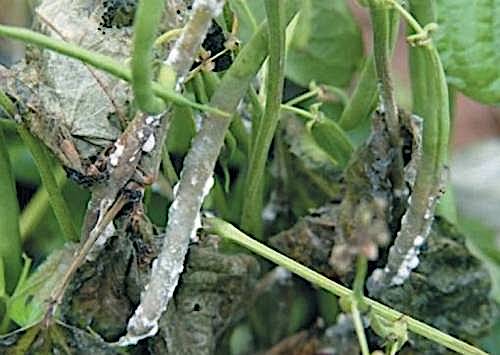
White Mold (Sclerotinia)
Most gardeners like to extend their vegetable production by planting fall crops, such as spinach, lettuce, radishes, turnips and brassicas (kale, broccoli, cauliflower). With the change in temperatures and shorter days, opportunities are optimal for these types of vegetables. Unfortunately, that change also means new threats emerge. Garden diseases aren’t only prevalent in the warmer months; they can strike in fall and winter, too. If you’re looking for an impressive winter harvest, it’s important to stay vigilant for diseases in fall. Regular monitoring, correct watering techniques and intervention as needed can keep your garden free of fall plant diseases. Catching these problems early stops a small problem from becoming an overwhelming one. There is a plethora of fall vegetable diseases, but we will concentrate on the diseases I have experienced in my Northern Virginia garden. Those diseases include White Mold, Gray Mold, Root Rot, Club Root, Downy Mildew and Cladosporium Leaf Spot.
White Mold is caused by a fungal pathogen Sclerotinia sclerotiorum. This fungus is a generalist, meaning that it has a wide host range but will affect fall cruciferous crops, such as broccoli, Brussels sprouts and cabbage. White Mold overwinters as sclerotia in the soil for many years. Under ideal conditions, extended periods of cool temperatures 50 to 70ºF (10 to 20ºC) and moisture, sclerotia within 1 inch (2 cm) of the soil surface germinate to form sexual fruiting structures called apothecia. Apothecia release ascospores, the infection unit of this fungus. The ascospores are disseminated by the wind and germinate when they land on an ideal host in a conducive environment. Disease development by white mold is optimal during cool, less than 80ºF (26º C) and wet/humid weather. This fungus produces white, cottony mycelial (fungal) growth on plant parts, mostly stems, petioles, crowns and fruits or pods, under conducive weather conditions. Furthermore, as the fungal growth progresses, small (less than 1 to 2 cm), irregularly shaped, black fungal masses called sclerotia can be found on or in the plant. The primary symptom seen on plants is an expanding discolored (bleached-to-greyish) lesion on the affected plant part. Lesions formed on stems can result in girdling of the stem and subsequent collapse of the plant above the point of infection. Infected petioles can result in defoliation. Fruits and pods that are infected by the fungus will be inedible.
Fungicides will not work once you observe disease symptoms; a preventative, not curative, measure is needed to control this disease. Some recommended practices are good air circulation around plants, no overhead watering, water early in the morning and remove and dispose of infected plant debris. If chemical prevention is preferred, use a fungicide recommended from the VCE 2026 Pest Management Guide — Home Grounds and Animals.
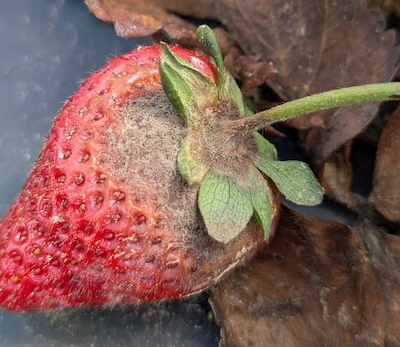
Gray old (Botrytis)
Gray Mold is caused by a fungal pathogen Botrytis cinerea. The disease is not host-specific. The number of plants that Gray Mold will attack is numerous to include all fall crops. This fungus produces a spore dispersed by wind, usually in abundance that gives infected tissue a gray to brown fuzzy appearance. With all host plants, it typically starts developing on dead or injured plant tissue, gaining energy to be able to infect healthy, living plant tissue. Gray Mold also produces sclerotia, which enable the pathogen to survive for years in soil. Optimum temperature range for growth of this pathogen is 70 to 77ºF (20 to 25º C); however, it is capable of growing over a wide temperature range 28 to 90ºF (-6 to 25 º C) with growth being very slow at the extremes. Symptoms may vary depending on the plants attacked, plant parts attacked and growing conditions. Under moist humid conditions, a grayish, thin mass of webbing (mycelium) may be visible. A structure called conidiophore that contain spores often develops in the “webbing.” When the infected plants are disturbed, large dusts like clouds of released disease spores may occur. Misty or rapidly rising humidity may also trigger the release of spores. Poor air circulation adds to the survival and growth of the disease. When temperatures are between 68 and 76 degrees and humidity is high, it takes about 20 hours for the disease to infect. Warm to hot dry weather tends to reduce or stop the growth and spread of the disease. This disease often over-winters on infected dead and live plant material.
The main method of control is sanitation. Clean infected debris from area and dispose of or bury in the ground at least a foot deep (do not compost). If chemical prevention is preferred use fungicide recommended from the VCE 2026 Pest Management Guide — Home Grounds and Animals.
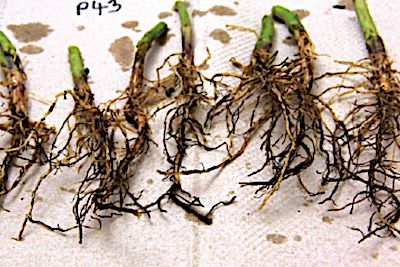
Phytopthora root rot on tomatoes
Root Rot can be caused by several soil-borne water molds or true fungi. Phytophthora spp. and Pythium spp. are both water-borne molds, and Rhizoctonia solani and Fusarium spp. are both true fungi. We will cover Pythium spp. in this article. Water mold Root Rot organisms such as Pythium produce thick-walled spores (called oospores) that can survive for long periods (years to decades) in soil. These organisms have wide host ranges, including fall vegetables, and prefer wet soil conditions. Gardeners often become aware of Root Rot problems when they see above ground symptoms of the disease. Plants with Root Rot are often stunted, wilted or have top-down dieback. They may also have leaves with a yellow or red color, suggesting a nutrient deficiency. Examination of the roots of these plants reveals tissue that is soft and brown.
The main method of control is reducing soil moisture. Provide enough water to fulfill a plant’s growth needs and prevent drought stress, but do not overwater. Remove excess mulch (greater than 4 inches) that can lead to overly wet soils. Buy plants from a reputable source and make sure they are Root Rot-free prior to purchase. Establish healthy plants in a well-drained site. Finally, minimize movement of Root/Crown Rot fungi in your garden. Dispose of affected plants. There are no chemical means of control on vegetables.
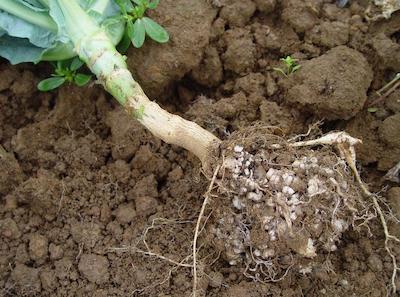
Club root on collard greens
Club Root of brassicas is caused by the soil microorganism Plasmodiophora brassicae. This microorganism is an obligate parasite that can only grow and reproduce in living roots. Plasmodiophora brassicae is capable of surviving in the soil for more than 10 years by producing thick-walled, resting spores. The severity of Club Root is heavily influenced by soil conditions. The pathogen germinates in wet soils when the soil temperature is between 64 to 70ºF (17 to 20º C), and the soil pH is acidic (pH less than 7.0). Resting spores respond to root exudates released from a susceptible host to form swimming spores (zoospores) that can move in water to infect roots. Zoospores infect susceptible plants through root hairs or wounds and form a plasmodium — a wall-less cell with many nuclei. The plasmodium releases more zoospores that cause new root infections. In time, the mature plasmodium is transformed into clusters of resting spores that are eventually released into soil as root decay. Characteristic symptoms are root distortion and galling (swelling). The galling symptoms give roots a ‘club-like’ appearance. This symptom is a result of the abnormal increase in cell growth and division. Galls are firm and have a white interior at the beginning of infection and eventually turn brown and decay. Infected plants may wilt during the day and recover at night due to the decrease in water and nutrient uptake as a result of the galls. Since growth is directed to the swelling galls, plants grow more slowly, are stunted, may have fewer, smaller leaves, and blue-green foliage. Keep in mind that other soilborne pathogens can cause these symptoms, so it is important to examine the roots for the characteristic swellings. The disease may progress extensively before above-ground symptoms develop.
Methods of control include sanitation of tools with bleach solution, buying disease-free transplants, crop rotation, reducing soil moisture and chemical application recommended by VCE 2026 Pest Management Guide — Home Grounds and Animals.
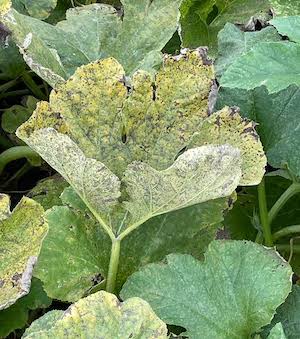
Downy mildew on pumpkins
Downy Mildew is the common name for a group of highly specialized obligate parasites of vascular plants. Downy mildews are generally favored by cool temperatures 58 to 72°F (14 to 22º C) and relative humidity above 85 percent at the leaf surface. Species of downy mildews reproduce sexually via oogonia and antheridia and asexually via sporangia. From the time of infection until new spores form can be as short as 4 days but is usually 7 to 10 days. In all species, the sporangia germinate directly by forming a germ tube that penetrates the plant. Downy mildew colonies often appear first on the underside of leaves, and they sometimes have a bluish tinge. In many cases, they can grow systemically throughout the plant. If growing abundantly on a leaf, downy mildew colonies can be confused with gray mold (Botrytis) or with powdery mildew. Microscopically, they are very easy to tell apart from powdery mildew and Botrytis. On the foliage, small yellow spots develop on the upper sides of the leaf while white to bluish-white fluffy growth forms on the underside of the leaf. As the leaf spot dies, the fluffy growth darkens to gray in color. Infected leaves and branches may be distorted and die.
Methods of control include removing plant debris from the area around the plant and disposing of it in closed containers. Space plants to ensure good air circulation around them so that when irrigated or subject to rainfall, leaf surfaces dry quickly. Overhead watering should not be used when the weather is generally cool. It is important, during cool damp weather in the fall, to scout highly susceptible plants to detect first infections. If chemical prevention is preferred, use fungicide recommended from the VCE 2026 Pest Management Guide — Home Grounds and Animals.
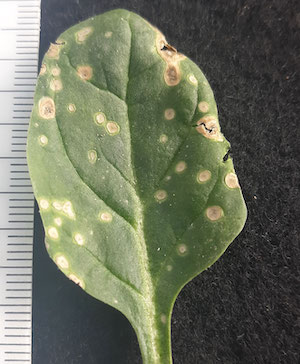
Cladosporium leaf spot on spinach
Cladosporium Leaf Spot is caused by the fungal pathogen Cladosporium variabile. It mainly infects spinach. Development of Cladosporium Leaf Spot is favored by cool, humid environmental conditions that often occur in the fall and in winter. Optimum conditions for infection are 59 to 68°F (15 to 20º C) and relative humidity above 80 percent, but infection can occur at temperatures between 50 and 86°F (10 to 30º C), and the fungus can continue growing at temperatures as low as 41°F (5º C). Spots caused by this fungal pathogen are round, small (up to 1 cm in diameter) and tan with green fungal growth (mostly spores) eventually developing in the center. This growth distinguishes this disease from anthracnose and Stemphylium leaf spot. Adjacent spots may coalesce, forming irregular lesions. In severe cases, older infected leaves may be killed. This pathogen can be seedborne. Its spores are dispersed by wind and splashing water.
Methods of control include no overhead watering. Promptly remove crop debris after harvesting to prevent carryover in soil. Hot water seed treatment can effectively eliminate Cladosporium from spinach seed. Treat spinach seed at 104°F (40º C) for 10 minutes to eliminate Cladosporium. Germination should not be affected unless higher water temperatures are used. If chemical prevention is preferred, use fungicide recommended from the VCE 2026 Pest Management Guide — Home Grounds and Animals.
The common factors in all these fall and winter woes center around cool wet soils, high humidity, sanitation problems and poor planting methods. Northern Virginia weather is conducive to this type of environment, so controlling that factor is difficult. But solid control methods that are within a gardener’s purview include no overhead watering and remove thick mulch to keep soil from becoming saturated. Remove plant debris, infected plants and dispose of them in closed containers. Buy disease resistant varieties if possible. Space plants far enough apart to allow good air circulation, so plants dry out between rain and morning dew. Stay vigilant in inspection of your plants for any early signs of the diseases. If chemicals are required, use the VCE 2026 Pest Management Guide — Home Grounds and Animals to identify which chemical is needed, and follow all label instructions on the product.
- References
- Results from Grower Survey about Diseases Occurring in Winter Greens, Margaret Tuttle Mcgrath, College of Agriculture and Life Sciences, Cornell University
- White mold, with a focus on vegetables, Chelsea Harbach and Lina Rodriguez Salamanca, Iowa State University Extension and Outreach
- Gray Mold (Botrytis), University of Illinois Urbana-Champaign, Illinois Extension Plant Problems
- Root Rots in the Garden, Brian Hudelson, University of Wisconsin Horticulture Division of Extension
- Downy Mildew, Gary W. Moorman, Pennsylvania State University Extension
- Spinach, Cladosporium Leaf Spot, Genevieve Higgins, University of Massachusetts Extension Vegetable Program