
Gomphrena Globosa around the Globe
by Susan Stager, Fairfax Master Gardener
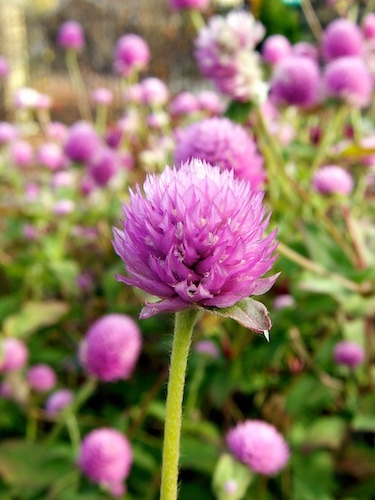
Gomphrena Globosa
If you are looking for a bright, colorful flower to grow in a sunny area that doesn’t get much water, Gomphrena is a good candidate. Also known as globe amaranth, Gomphrena globosa (gom-FREE-nuh gloe-BOE-suh) is a summer annual that can be used in containers, rock gardens, as a mass planting, or as an edging plant. You can also dry it for indoor use.
Gomphrena is the Latin name for a type of amaranth. Globosa refers to the round shape of the flowers. Amaranths are purple in color; some are grown for food. The papery-textured gomphrena attracts butterflies, bees and other beneficial insects, and blooms from June to the first frost in fall. Native to Central America and Mexico, gomphrena is now grown globally and is not aggressive.
Most of the globe-shaped “flower” is actually made up of papery “bracts.” Bracts are modified leaves that look like flower parts. They protect young flower buds from the elements by enclosing the floral organs. They also attract pollinators or protect fruits. In Gomphrena, these bracts stay on the plant; others fall off or fade away as the plant matures. Bracts may resemble and are sometimes mistaken for other flower parts.
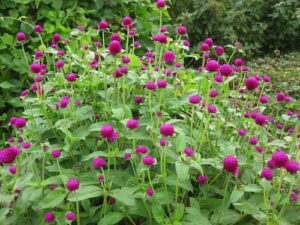
Gomphrena ‘Magenta’
These globe-shaped flowers grow to 18 inches (45 cm) tall and about a foot wide, and come in purple, pink, yellow or white. The purple is most common in retail nurseries. It is very heat tolerant once established. It needs six or more hours of direct sun per day, and soil with good drainage that is occasionally dry and does not like overwatering. It also tolerates clay soil. For a mass planting, space them 12 to 18 inches (30 to 45 cm) apart. The germination rate of this annual can be low; therefore, it is best to be generous when sowing seeds.
The leaves on gomphrena are long and slender; when young, they are wooly white, turning hairy as they age. The hairy foliage easily collects dirt, so apply mulch around the plants to keep a clean look. Some varieties tend to sprawl when growing alone. Taller plants can be staked, or, if you enjoy its open branching nature, it mixes well with other loose informal flowers.
Gomphrena haageana is a tender perennial native to Texas, New Mexico and northeastern Mexico in red and orange shades. If planted alone, it sprawls, and it can be staked, or paired as mentioned above.
To encourage a bushier plant, pinch out the first flowers. You’ll get more blooms if the plant is cut regularly. Gomphrena does not suffer significantly from insect or disease problems. Cultivars may introduce issues with mold, root rot, stem rot, powdery mildew and leaf spots.
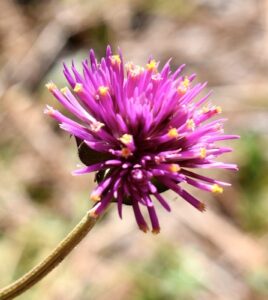
Gomphrena ‘Fireworks’
There are several cultivars.
- ‘Bicolor Rose’ has rose-colored blooms with white centers; grows 6 to 8 inches (15 to 20 cm) tall
- ‘Buddy Series’ is purple, rose or white and dwarf, 9 to 12 inches (20 to 30 cm) tall
- ‘Cosmic Flare’ is 15 to 24 (40 to 60 cm) inches tall with raspberry pink flowers and lime-green foliage
- ‘Fireworks’ is pink to magenta with a long growing season; grows 3 to 4 feet (90 to 120 cm) tall
- ‘Gnome Series’ grows 6 to 12 inches (15 to 30 cm) tall with small clover-like blooms
- ‘Pinball Series’ grows 10 to 14 inches (25 to 35 cm) tall in soft lavender, bright purple and snowy white
The purple gomphrenas pair well with yellow flowers such as lantana, butter daisies (Melampodium) and marigolds. Pink or rose flowers look pleasing next to dark-leaved plants such as burgundy-leafed coleus or ‘Blackie’ sweet potato vine. Consider alternating rose-colored gomphrena and blue salvia (Salvia farinacea) behind white sweet alyssum or cup flower (Nierembergia for good effect.)
To use as dried flowers, harvest the blooms when they are completely open. If the blooms are too old, they may fall apart after they are dried. Cut and hang upside down in bunches to dry.
In Nepal, gomphrena, called the ”Makhmali” flower, are worn as a garland during the Tihari festival, celebrated throughout the Nepali diaspora in the fall.
- References
- Globe Amaranth, North Carolina State University Extension Gardener Plant Toolbox
- Globe Amaranth, Gomphrena globosa, Susan Mahr, Wisconsin Horticulture Division of Extension
- Gomphrena globosa, Common Globe Amaranth, University of Florida, Institute of Food and Agricultural Services
- Bract, Glossary, Master Gardeners of Northern Virginia