
Pyracantha – Firethorn
by Bryan Kiser, Fairfax Master Gardener
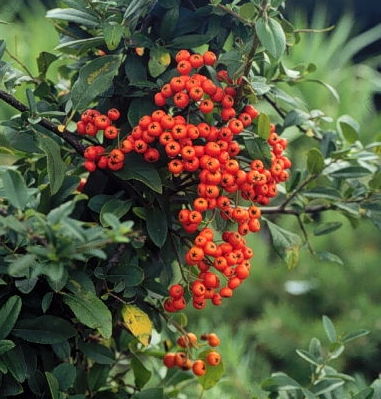 Pyracantha, or commonly known as firethorn, is a tenacious genus of thorny, evergreen shrubs in the family Rosaceae native to southeastern Europe and Asia. The genus name Pyracantha, comes from Greek pyr “fire” and akanthos “thorn”, meaning firethorn. Pyracantha are cultivated in North America as ornamental plants. All species have glossy green leaves, which are ½ to 1 inch (1 to 2 cm) wide and 1 to 4 inches (2 to 10 cm) long. They have long very sharp thorns along the branches. They bear flowers and fruit on spurs along the wood of last year’s growth. Flowers appear in spring: they are small, white and have an unpleasant smell. The berries are the main reason for the shrub’s popularity. In the fall, they appear in thick clusters and range from orange to red in color, depending on the species and cultivar. The berries can last until late winter, making them a popular food source for birds when other food sources are limited.
Pyracantha is a rampant grower sometimes as much as 2 feet (60 cm) a year. It is considered invasive in many areas. It produces sharp thorns, which make it a good, deer-resistant barrier plant for the perimeter of a landscape, but it can be problematic in a small yard or when spreading in unwanted areas. Other suggested uses for this plant include border, hedge, accent plant, espalier, cover for dry slopes and a natural fence. Some dwarf varieties also grow well as container plants. Planting around the foundation of single-story buildings is not recommended because it grows too large and fast. Shrubs should not be planted in high traffic or play areas where people may encounter thorns. Thorns are easily able to puncture human skin, which can cause slight inflammation and severe pain. I can attest to this problem; we have a pyracantha planted next to our sidewalk, and it can be very prickly. Choose carefully where you plant this shrub. Pyracantha resent transplanting. Therefore, once it is planted, leave it alone.
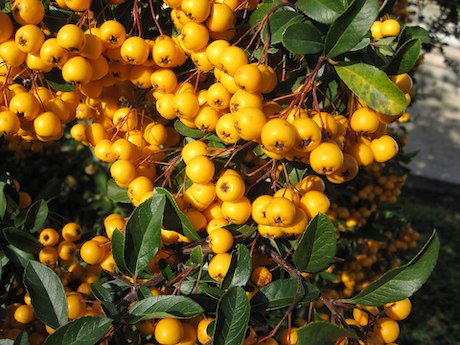
Yellow pyracantha berries
Pyracantha prefers moist well-drained soil in full sun to partial shade and can tolerate a wide range of soil pH from 5.5 to 7.5. The USDA Cold Hardiness Zones for Pyracantha can range from 5 to 9 depending on the cultivar. Avoid planting pyracantha in highly fertile soil or over-fertilizing. Excess nitrogen promotes rampant growth that makes the plant more susceptible to fire blight. Once established, the shrubs are heat and drought resistant but mulching around the shrub is a good practice to reduce stress from dry weather. It is best to plant pyracantha shrubs in the spring. Dig a hole at least twice the size of the root ball and just as deep. Place the shrub in the hole and backfill with the original soil so that the top of the root ball is flush with the soil. Tamp down the soil, and water it well. Water it deeply and regularly during the first growing season.
You can propagate pyracantha from cuttings. In the summer, take a 6-inch (15 cm) semi-hardwood cutting and remove all the leaves from its lower end. Dip the cut end in rooting hormone powder and insert it in a 4-inch (10 cm) pot filled with damp potting mix. Keep the cutting moist in a moderately warm location in bright light and away from intense sunlight. When you see new growth, roots have formed. Wait for the sapling to grow into a vigorous plant with the roots filling the whole pot before transplanting it into the landscape.
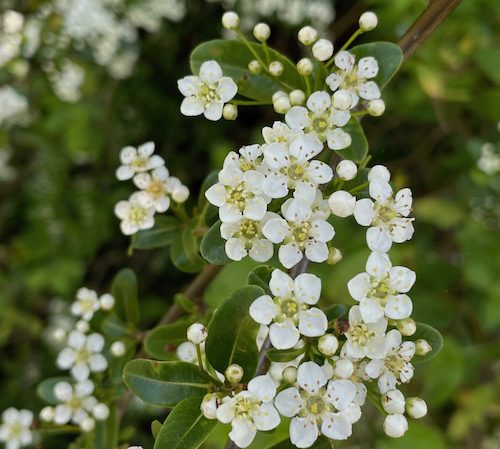
Spring flowers on pyracantha
Pruning pyracantha is essential and can be accomplished anytime of the year but is recommended in late winter and early spring. Pruning in late summer or early fall would reduce the flower and berry production, plus any new growth stimulated by late pruning could be cold-damaged. Flowers and berries are produced only on at least one-year-old growth. Always leave some of the growth made each year to have flowers and berries. Pyracantha can be selectively pruned to leave enough flowers for berries in the fall. Pruning is also used to keep it in bounds and to remove any wayward branches. It is essential to dislodge old, withered or rotted berries with a broom at the end of winter. Another pruning tip is to wear gloves due to possible allergic reactions to the spines.
Common problems with pyracantha include fire blight, scab and select insects. Fire blight is a bacterial disease that can kill the plant. Scab, a fungal disease, causes defoliation and turns fruit a dark, sooty color. The best means of fire blight and scab prevention include selecting resistant varieties and avoiding excessive nitrogen. Pests include aphids, scale, spider mites and lace bugs. Control/prevention of these pests can be accomplished by following recommended methods and pesticides in the Virginia Tech Pest Management Guide.
The following are suggested cultivars of pyracantha:
- ‘Apache’ grows to 5 feet (1.5 m) high and 6 feet (1.8 m) wide and has large, bright red berries that last well into winter. This selection is resistant to fire blight and scab.
- ‘Fiery Cascade’ grows to 8 feet (2.5 m)tall and 9 feet(2.7 m) wide, has orange berries that turn red during the winter and has good disease resistance.
- ‘Mohave’ grows to 12 feet (3.5 m) tall and wide and has many big orange-red berries, which last well into winter. This selection is resistant to fire blight and scab.
- ‘Teton’ is cold and hardy and grows 12 feet (2.5 m) high and 4 feet (1 m) wide. The berries are golden yellow. This selection is also resistant to fire blight and scab.
- ‘Navaho’ has bright red-orange berries. It prefers well-drained soil in the sun. It has a good scab and fire blight resistance.
- ‘Ruby Mound’ is a dwarf pyracantha cultivar that grows 4 to 5 (1 to 1.5 m) feet tall. It has red fruits and has a mounding habit.
- ‘Rutgers’ grows to 2 to 3 feet (0.5 to 1 m) tall and spreads 4 to 5 feet (1 to 1.5 m). The berries grow in clusters of small orange and red berries.
- ‘Tiny Tim’ is a compact plant that grows up to 3 feet (1 m) high with small leaves and few or no thorns. The berries are red.
- ‘UNCC Dwarf’ has small and show orange-reddish berries and grows up to 4 feet (1.2 m) tall.
- References
- Pyracantha (Firethorn) Care Guide: Growing, Pruning, and Landscape Uses, Clemson College of Agriculture, Forestry and Life Sciences
- Scarlet Firethorn, Pyracantha (Pyracantha coccinea), VCE Publications/ 2901/ 2901-1067
- Pyracantha coccinea, North Carolina Extension Gardener Tool Box