
How to Feed the Birds in Winter
by Ray Novitske, Fairfax Master Gardener
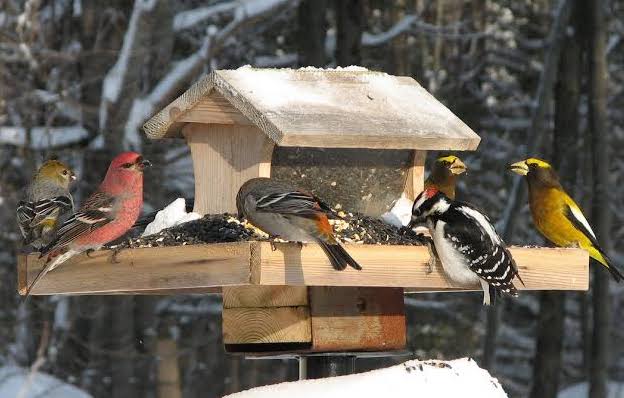
Hopper style bird feeder
Who hasn’t looked out their window in the middle of winter, seen birds trying to survive the cold and snow, and wanted to help them. It is our nature to believe that feeding them through the cold season will lead to surviving the winter. Let’s explore if this is necessary.
A recent study suggests that people who feed birds often display better overall health and mental well-being (Dayer et al. 2024). Many of us agree with this. Fifty million citizens nationwide spend $4 billion annually on bird seed, feeders and bird-watching equipment. Hyped by advertising and marketing, many myths play a role in sales that might be causing some harm instead of providing a helping hand to our feathered friends.
The first myth: Birds need our help to survive. Remember our winter birds have survived for centuries quite well on their own without supplemental nutrition from humans. Although our suburban environment may be more challenging for some species, they can generally find the food they need through the winter. Those species that cannot have evolved to migrate to warmer areas.
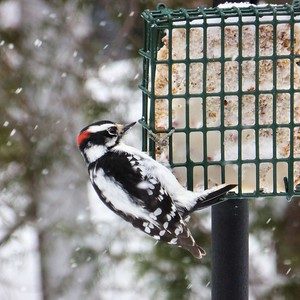
Suet feeder
The 20 percent that migrate are usually looking for warm temperatures; sure, but they also prefer to dine on insects and plants. The seasonal decline in these food sources and availability leads them to seek it elsewhere. Those species that remain find seed and berries as the best food source.
One questions if our backyard feeders will make a difference to our winter bird populations by supplying an abundance of readily available food. Could the reliance on our feeders create a dependence on us? A study of black-capped chickadees by the University of Wisconsin finds the answer is no. Researchers found that there was no difference in survival rates between chickadees that had constant access to feeders and those that relied on natural sources. Further research shows that the feeding v. not feeding results vary across different species and conditions, with no overall positive or negative impacts.
Feeding birds can be harmful to them if we promote an increased spread of disease from poor maintenance and increased danger from predators. Strict sanitation measures must be observed to prevent disease. Salmonella bacteria, parasites and fungal infections are all possible in infected feeders and can be transmitted to other birds at the feeders. Droppings below a feeder can also promote disease.
At a minimum, all feeders should be taken down, emptied of all contents and cleaned at least once every two weeks. Seeds should be kept dry since wet conditions encourages growth of some diseases. Store seed in a dry area, and discard any seed that feels damp or clumps together. Also use a feeder that keeps seed dry in a covered or enclosed vessel. If signs of sick birds are observed such as swollen, crusty or shut eyes, or loss of down, take the feeder out of service for a few weeks before supplying it again to disperse the regular visitors. Then start it up again.
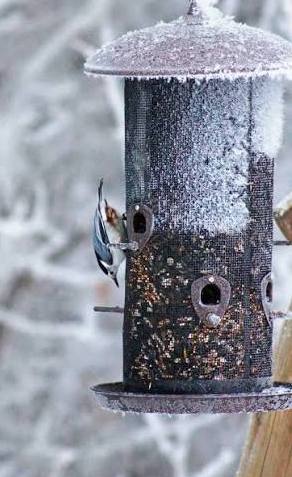
Tube feeder
Removing the spent seed below a feeder is a good sanitation practice. The accumulation can attract other animals such as rats, rodents and skunks, as well as predators that hunt the birds you are trying to help. Cooper’s Hawk and Sharp-shinned Hawk prefer to take advantage of your feed to attract their prey and have been known to hunt at feeders. Birds prefer a feeder in a location with a clear line of sight for escape and with some protective cover nearby for hiding, such as an evergreen shrub or tree.
There are no good answers to marauding squirrels. There are various contraptions and inventions available online to protect feeders. Otherwise, place feeders on poles away from nearby jumping-off locations. Check shops for squirrel-resistant designs.
Where a feeder is placed can determine which birds will be attracted to it. Birds that usually feed in trees will respond to hanging feeders with perches. Tube feeders and hopper-style feeders are designed to allow birds to extract seeds. Birds that feed on or near the ground will appreciate tray feeders and often ignore hanging feeders.
We like to place feeders near our windows for bird-watching, but birds mistakenly fly into glass when fleeing potential predators or a perceived threat. They see the reflection of landscape and see it as an open escape area. A screen or reflecting ‘scare’ devices to prevent injury are good alternatives.
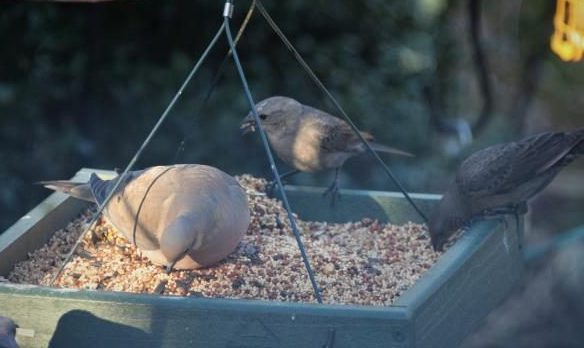
Platform feeder
A majority of common birds that visit feeding stations show a clear preference for black oil sunflower seeds. These have a higher fat content than striped sunflower seeds, so there is a larger nutritional benefit. Birds with small, thin beaks prefer soft pliable foods while birds with strong beaks have the strength to crack open nuts and shells of larger seeds. Ground feeders prefer millet and cracked corn. Larger shelled nuts and seeds are preferred by larger birds. Suet and peanut butter provide high-energy nutrition, making them perfect for small birds on cold days. These can be served in mesh feeders or on open platforms.
Various feed and seed are preferred by different birds. Cardinal mixes of black-oil sunflower and peanuts are popular with cardinals, blue jays and finches. Peanuts are loved by chickadees, nuthatches and woodpeckers. Small thistle and millet attract juncos and finches. Titmice and wrens like small seeds, suet, unsalted peanut butter and berries. And of course, to attract downy woodpeckers, you must have suet.
Keep these tips in mind this winter to keep the birds safe and well-fed until spring.
- References
- Feeding Birds, All About Birds, Cornell Lab of Ornithology
- Feeding Wild Birds: Should People Feed Birds and What’s Best to Feed Birds?, James A. Parkhurst, Virginia Tech
- Winter Bird Feeding: The Basics, Heather Beck & Margaret Brittingham, Penn State Extension