
The Other Dogwoods In Virginia
by Elaine Pugh, Fairfax Master Gardener
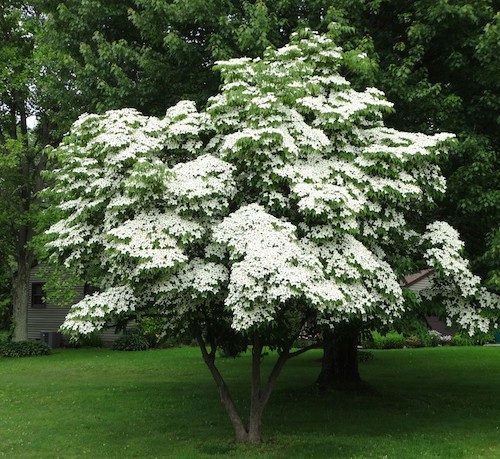
Kousa Dogwood Tree
The Virginia Department of Forestry website lists five dogwoods recommended for Virginia. We are all familiar with the Virginia native and our state tree, the dogwood (Cornus florida), and the mostly shrub-like Red Twig Dogwood (Cornus sericea). We present the following additional dogwood trees to round out the Department of Forestry’s list, and add a European import, too.
Cornus kousa, the Kousa dogwood, is not a native, but it is a good tree option for Cornus florida if you have disease or insect problems with the flowering dogwood. The Kousa dogwood is a vase-shaped or more rounded tree at maturity (or a multi-stemmed shrub) that grows about 15 to 30 feet (5 to 9 m) tall, with oval, pointed dark green leaves measuring 4 inches (10 cm) long.
It features tiny flower clusters surrounded by four narrowly pointed, petal-like white bracts that are not unlike our native dogwood. These flower bracts emerge nearly a month later than those of native species. Its flowers stand out against the green leaves. The tree produces pinkish-red, round, bumpy, berry-like fruits about 1 inch in size (2 cm), displays shades of reddish-purple to scarlet in fall, and has mottled tan-and-gray exfoliating bark that adds winter interest.
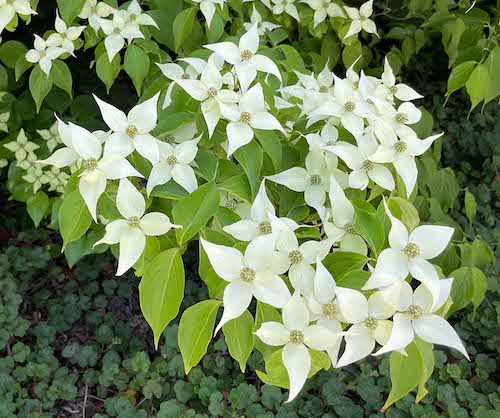
Kousa Dogwood Flowers
The Kousa dogwood prefers organically rich, medium-moisture, acidic to neutral, well-drained soils and grows in full sun to part shade. It needs regular moisture during hot summers. It tolerates deer and attracts butterflies and birds.
Plant as a specimen or in small groups, shrub borders, woodland gardens, bird gardens or naturalized areas. There are no serious insect or disease problems. Leaf scorch may occur on trees planted in full sun if the soil dries out. Note that It blooms after the leaves emerge and offers good fall color.
Cornus mas, also known as Cornelian Cherry, is another member of the dogwood family. This European native tree is deciduous and typically grows to 15 to 25 feet (5 to 8 m) tall. The exfoliating bark on the trunk develops on mature trunks and adds visual interest to the garden.
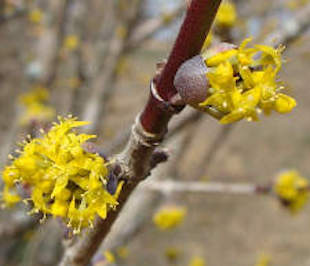
Cornus mas Flowers
It flowers in early spring before the leaves emerge with small yellow blooms arranged in small clusters. Small edible red berries appear in fall, giving it its name, although they are quite sour.
It prefers full sun to part shade, and prefers moist, well-drained rich soils. It is known for its excellent resistance to anthracnose and dogwood borers, and is used for its landscape appeal, winter hardiness and pest resistance.
Cornus racemosa, Gray dogwood, is a multi-stemmed native shrub that grows to about 10 to 15 feet (3 to 5 m) with a similar spread, with grayish-green elliptic to lance-shaped leaves 2 to 4 inches (5 to 10 cm) long, white flowers borne in terminal racemes, and white berry-like drupes. It has dusky purplish red fall color and smooth gray, mature bark. Terminal stems holding the flowers, then drupes, are distinctively red and provide an interesting contrast.
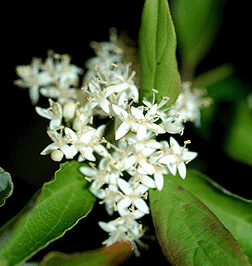
Gray Dogwood Flower
The Gray dogwood prefers moist soil but can also tolerate dry, wet and poor soils. It grows in full sun and partial shade, and has no serious disease or pest problems.
It grows in poor soils, tolerates deer and wet conditions, displays showy white fruit, has red terminal stems with gray bark and attracts butterflies and birds. Group plantings to spread in naturalized areas, native plant gardens, rain gardens, shrub borders, property-line screens or along streams for erosion control.
Cornus amomum, Silky dogwood, is a multi-stemmed native shrub with an oval-shape that grows 6 to 12 feet (2 to 4 m) tall. It has oval to elliptic medium-green leaves measuring 2 to 5 inches (5 to 12 cm) long with conspicuous veins, and tiny yellowish-white flowers arranged in flat-topped clusters that bloom from late spring to early summer. The leaf undersides and twigs have silky hairs. It has berry-like drupes that ripen from white to blue and dark-red-purple twigs with smooth gray bark.
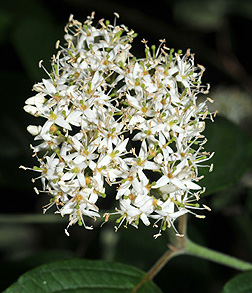
Silky dogwood Flower
It tolerates deer, wet soils and the roots of black walnut trees. Attracts birds. Plant in moist to wet areas such as woodlands, naturalized areas, along streams/ponds or for erosion control. Not a specimen plant.
As with the Gray Dogwood, there are no serious insect or disease problems, but branches that touch the ground may root at the nodes and spread into a thicket.
-
References
- Dogwood, Virginia Department of Forestry
- Kousa Dogwood, Virginia Tech Dendrology
- Gray Dogwood, Virginia Tech Dendrology
- Silky Dogwood , Virginia Tech Dendrology
- Cornus mas, North Carolina State Extension