
Xeriscaping – Use Less Water
by Mimi Dunham, Fairfax Master Gardener
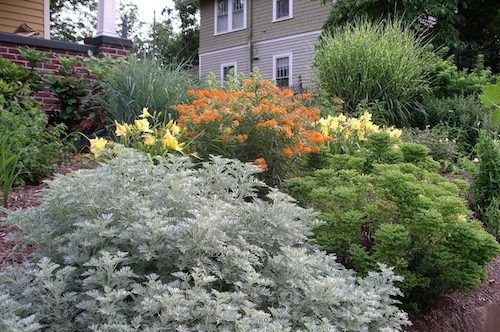
Front Yard Xeriscaping
The lawn and garden can account for 50 percent of a homeowner’s water usage. Turfgrass requires substantial water to maintain its green appearance. Landscape design and water management can work together with nature and natural forces to create an aesthetically pleasing environment that uses less water from local sources.
The principles of water-wise landscape management include careful observation and measurements, choosing the right plants for your area, preparing soils and watering properly. This approach to water-wise landscaping is referred to as xeriscaping, “xer-“ for dry and “ -scape” for scene or view. Here is a phonetic hint for pronunciation: ze·ruh·skay·ping.
Reducing or eliminating lawn area is a high-impact change for reducing water usage. When you create a detailed plan for your lawn, some grassy areas might be swapped for wood decks or stone patios for entertaining rather than high-maintenance lawn grass. Ensure that water can flow through the deck boards and gravel stone to nourish the soil.
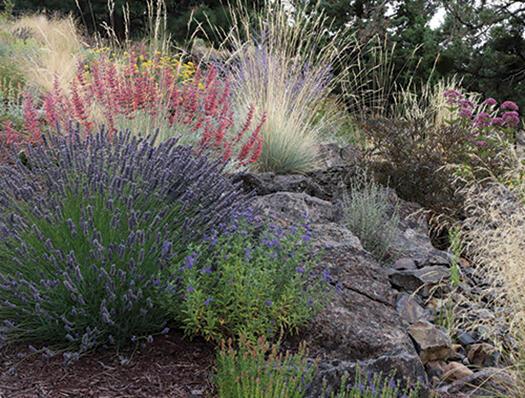
Xeriscaping on a Slope
Xeriscaping is also beneficial on steep slopes or irregular yard areas where water accessibility is more difficult. Ways to limit lawn area include installing ground cover and increasing garden beds and mulched areas. Installing walkways will also decrease the lawn.
There are several other benefits of xeriscaping. With changing global weather patterns, we need to learn how to limit water usage in our gardens and vegetable plots. This method also provides a habitat favorable to animals and insects.
A water-conserving xeriscape is created by selecting plants that can withstand drought and by not planting densely. These choices are integrated with garden design, mulch selection, watering methods and grouping plants with the same water requirements.
Soil improvement is also part of a water-wise garden. Adding organic matter, such as compost, not only prevents moisture loss but also results in well-draining soil. In general, incorporate 2 to 3 inches of compost, shredded leaves and other fine organic matter into the soil every year. Sandy soil will hold water and nutrients more efficiently when organic matter is folded into the soil. Clay soil also benefits from organic matter, which helps it absorb water faster and reduce erosion and runoff.
A thorough plan for dry landscape or xeriscaping is one with drought-tolerant trees, shrubs and ground covers, especially native plants suitable for your zone. Fairfax County is mostly Zone 7a or 7b, with a little 8a. Limit plants with higher water demands to smaller areas that can be watered efficiently. Ground covers can look attractive and can be shaped to fit edges and walkways. Allow leaves to accumulate beneath trees and stop raking. Add grasses to your property that don’t need as much water. Shade trees can be planted on the west side of the house that will conserve water.
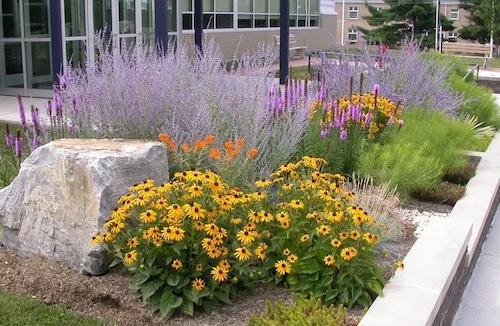
Colorful Blooming Plants for Xeriscaping
Do some research to select native plants that are drought-resistant for your specific area. Some examples include cactus, stonecrop, yucca, agave and mountain mint. Woody perennial herbs such as sage, rosemary, chives, thyme and catmint also need less water. Ornamental plants such as yarrow, ice plant, blanket flower, black-eyed Susan, echinacea, California poppy, marigolds, gaillardia, yellow sundrops and grasses also fall into this category.
Mulch keeps the soil moist, which limits the amount of water needed. In addition, mulches help control unwanted plants, such as weeds, that compete for water and nutrients. Mulch also moderates ground temperature extremes. In addition to purchased mulch, include wood chips, compost, pine needles or leaf litter. Stone or gravel mulch allows rainfall to penetrate the soil and offers an interesting visual contrast on edges and walkways.
Xeriscape maintenance is much easier once plants are established and watering chores are reduced, but frequent watering may be required to establish plants initially. Drought-tolerant plants grow more slowly, which decreases pruning chores and decreases the amount of yard waste.
Your garden and lawn should receive enough water to wet the soil to the bottom of the root zone each time you water, which often is satisfied by 1 inch per week. You can check this by digging a small hole in the watered area, 5 to 6 inches (12 to 15 cm) deep, to see if it is damp at the root level. Using a slow-drip hose or trickle irrigation system can provide the precise amount of water needed. You should avoid watering by hand because this tends to add water faster than the soil can absorb, leading to runoff and a lack of water in the root zone. One way to water by hand is to place a bucket with holes in the bottom next to the plant and fill it with water, which will drain slowly. Then move it to the next plant. Some conservation practices use a rain barrel and water, with a hose or pipe, to deliver water under stone mulch to plants.
If you use a sprinkler system, minimize evaporation by watering in the early morning and be careful not to water your driveway pavement, sidewalks, patios and streets.
Another alternative is to create zones with higher water usage plants in the front yard or garden, while the backyard or areas further from your home can hold drought-tolerant plants. Stone paths can add interest, leading viewers’ eyes to landscaped spots while reducing the need for plantings.
A rain garden can capture rainwater to sustain a small garden bed, mitigating storm runoff, erosion and flood damage. Basically, it is a trench or garden bed into which runoff from your roof, driveway or yard is directed. It flows directly into the area filled with thirsty plants. Do not install them too close to your house and avoid any septic field. A test hole about a foot deep should drain in a day. The rain garden should be matched to your roof by sizing it to about one- sixth of the house area. This supports efficient water usage. Dig down about 6 inches and keep the bottom level, using the removed dirt to berm the slope downside of the hole.
Xeriscaping can address water conservation needs while still allowing creative styling and design of an attractive landscape garden. Instead of irrigating and nursing a needy lawn, you can create a mini-oasis that looks great, saves on the water bill and helps the environment.
-
References
- Creating a Water-Wise Landscape, Joyce Latimer and Alex Niemiera, Virginia Cooperative Extension, (426-713 HORT-200P)
- Conserve Water in Your Landscape, Christa Carignan, University of Maryland Extension
- Xeriscaping: Retrofit Your Yard, John Murgel, Colorado State University Extension
- Conservation At Home, Protecting Water, National Park Service
- Xeriscaping with Drought-Tolerant California Native Plants, California Native Plant Society