
Dragonflies and Damselflies
by Jan M. Pickrel, Fairfax Master Gardener
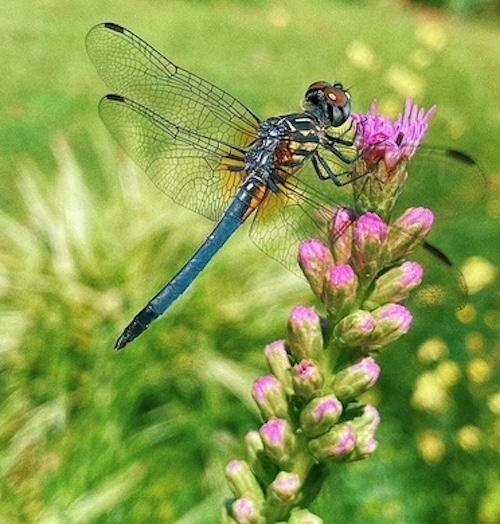
Blue dasher
Dragonflies and damselflies are colorful insects that appear to innocently and playfully dart and swoop about our gardens in straight lines or in seemingly random dances.
Dragonflies and damselflies are cousins of the same order, Odonata, but their family resemblance stops there. In comparing the insects in their winged adult forms, both insects have two sets of nearly clear, paired wings. The damselfly’s forewings and hindwings are nearly identical in size and slender shape. The dragonfly’s hind wings broaden at the base. While at rest, the damselfly can fold its wings alongside its body. In contrast, a dragonfly holds its wings fully extended and perpendicular to its long body. Although both insects have two large compound eyes and three simple eyes (five in total), the damselfly eyes are wide-set and located on opposite sides of its head. The dragonfly’s huge eyes meet, sometimes touching each other, at the top of its head.
Despite all of these differences in their adult form, as their order name Odonata denotes, both the dragonfly and damselfly have strong jaws with teeth and are considered as aquatic predators. While growing through their larvae (nymph or “naiad”) stages underwater, they eat other aquatic nymphs and even, if the opportunity arises, small fish. As adults, both are welcomed by many gardeners for their diet of mosquitoes and pesky gnats, though they also will sometimes eat beneficial pollinators that stray across their paths.
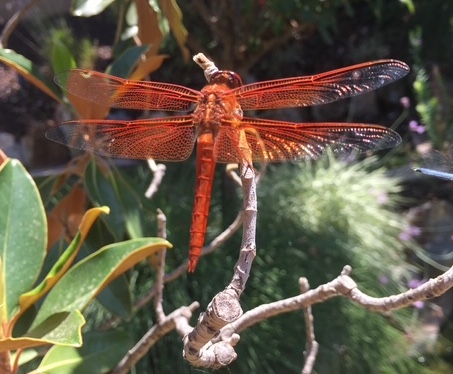
Flame skimmer, libellula saturata
Virginia is host to one of the most diverse Odonata (dragonfly and damselfly) faunas of any state or province in North America. The referenced checklist of 144 dragonflies and 55 damselflies includes all species that have been documented to occur in Virginia. The common names adopted by the Dragonfly Society of the Americas follow. Capitalized names are the scientific Family names. The chart also lists the Virginia flight date and habitat. The abundance column (rare, uncommon or common) refers to the status of each species in Virginia. Many of the species listed as “rare” are more common in neighboring states, but reach either their northern or southern range limit in Virginia. Species listed as historical have not been documented in the state in the past 40 years.
Depending on the species, adult dragonflies may lay their eggs directly into water, in shoreline mud or even in hollow reeds of aquatic vegetation. Nymphs initially emerge from their eggs and breathe oxygen via gills for their interim lives underwater. They undergo 8 to 15 instars (incomplete molting phases) before surfacing for a final instar to become winged adults. The length of the dragonfly’s life cycle or span in any one of their stages also varies species to species, some growing from nymph to reproducing adult within a single month, and other species’ eggs might enter a “diapause” and not emerge to its aquatic stage for a year following when its egg was laid. So far, the reasons and time period for when the green darner adopted this life cycle uniqueness are unknown. Theories include that the diapause was a response to temperature and/or drought stressors as a reproductive survival technique.
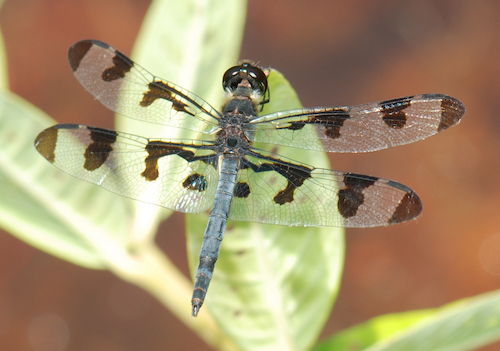
Banded pennant, Celithemis fasciata
Within the last 10 years, researchers from the Smithsonian Conservation Biology Institute, Vermont Center for Ecostudies, and the University of Maryland, aided by citizen scientists, have identified the annual north to south (and reverse) migration pattern of the green darner dragonfly, with three generations to complete the journey. Stable hydrogen isotopes detected and traced in wings of the green darner were correlated and mapped geographically to hydrogen atoms in rainfall where green darner naiads began the aquatic portion of their lives. In summary, adult dragonfly northbound migration flights are triggered by minimum water temperatures of 9.17°C (48°F), typically in January, along the Gulf of Mexico coast, and continue for approximately 660 km (approximately 435 miles) and spanning 50 to 60 days. At that time and location, the adult lays eggs and dies. Then a new generation begins the northward trek, for three generations, to the United States and Canada border, before the seasonal water temperature changes, typically in August. The next darner generation begins southward migration for the autumn and winter.
As stated above, both the dragonfly and damselfly live most or all of their juvenile lives as nymphs underwater, typically in standing or slow-moving water. This aquatic dependence for reproduction and food sources makes their survival susceptible to droughts and habitat destruction. To attract dragonflies to your garden, knowledge of the different species already living in your area and their particular habitat requirements will identify design elements necessary: water depth, pond substrate composition and native water plants. Eliminating the use of pesticides and chemical fertilizers is also crucial for the insects’ survival as well as their food sources. Even though we humans might be comforted by the dragonfly’s and damselfly’s taste for mosquitoes, many home gardeners might be reluctant to provide a haven of standing water that might increase mosquito populations. Nevertheless, even if pond building is not in your garden’s future, providing a temporary water stop (birdbath) and a diverse and native horticultural selection for pollinators may provide sustenance for their flirty appearance. Their presence is considered indicative of a diverse ecosystem that is benefiting from generally good quality water, and there is little wonder why many cultures consider dragonflies to be symbols of good luck and prosperity.
- Resources
- Checklist of the Dragonflies and Damselflies of Virginia, Virginia Department of Conservation and Recreation
- Sustaining America’s Aquatic Biodiversity – Aquatic Insect Biodiversity and Conservation, Virginia Cooperative Extension (420-531)
- Move Over Monarchs, VCE and Colleagues Reveal Astonishing Dragonfly Migration, Vermont Center Ecostudies
- Three generations, Thousands of miles: Scientists unlock the mystery of a dragonfly’s migration, University of Maryland Baltimore County