
Imported Euonymus Scale
by Nancy Miller, Fairfax Master Gardener
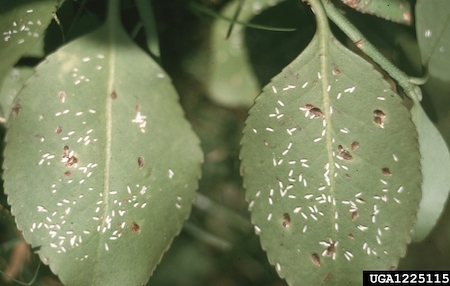
Euonymus scale on leaves
Euonymus scale, Unaspis euonymi, is a type of armored scale insect native to Japan and China, but well-established in North America. It is from the order Hemiptera, true bugs. While it is most fond of Euonymus, the deciduous, vining and evergreen varieties, the Euonymus scale includes a wide variety of hosts in its diet, including pachysandra, bittersweet, invasive Oriental bittersweet, boxwood, burning bush, English ivy, (also invasive), holly, honeysuckle, and lilac. Do you grow any of these plants (intentionally or not) in your yard? If so, now is the best time to find this scale and learn how to treat it.
When an infestation starts, the plant may seem water-stressed or thin and less vigorous. It may be losing leaves in mid-summer, or its leaves look spotted. Scales cause injury to plants by removing fluid from non-vascular plant cells. Scales have piercing-sucking mouthparts that result in a reduction of plant health with yellowish stippling or spotting of foliage. Light infestations on a leaf’s underside could make yellow spots on the top of the leaf. Moderate infestations will cause stagnated growth and stunting and leaves with yellow spots. Heavy, prolonged infestations could result in the death of a branch or the entire plant. These infestations can occur on twigs or leaves. Both sexes of Euonymus scale are easily observable on plants: mature females will be mainly on the bark of branches while immature males will be mainly on the foliage.
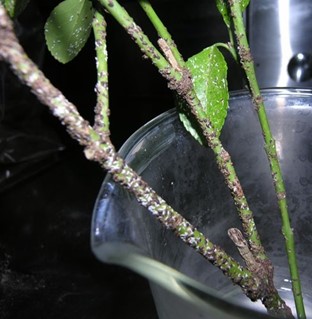
Euonymus scale on branch
The life cycle is simple: pregnant females overwinter on a plant’s bark as fertilized females. They lay eggs under their protective waxy cover in late April and May, which hatch over two to three weeks. These first instar nymphs are crawlers. They wander over bark and foliage, then settle and begin to feed. At this stage, they are about .3mm long and yellowish orange. In four to six weeks, they completely develop into adults. Males are elongated, 1/32nd of an inch (1 mm) long, with a narrow waxy cover with a tannish, yellow cap at one end and three ridges running down the length of the scale covering. They emerge as tiny wasp-like insects. Females are oyster or pear-shaped, gray-brown, 1/16th of an inch (2 mm) long and flattened. Adult males feed, develop under their waxy covers, mate with females and die. There is a second generation with crawlers emerging in late July and August. There could be another generation, but it is unlikely in our area. After this final mating, the pregnant females hibernate on bark over the winter, and the cycle begins again in the spring. All stages of Euonymus scale are yellow under the waxy coating.
Because of this regular cycle, it is possible to predict when the most vulnerable stage — crawlers, the only mobile stage of the life cycle — will occur. Around 522 growing degree days, or after the tulip poplar and green hawthorn have bloomed and before the American smoketree blooms, the first cycle of crawlers will start emerging. Then the second set of crawlers will start at around 2,235 growing degree days, or during the flowering of Japanese pagoda tree and before the first flowering of Natchez crape myrtle. Translated, that means it is best to start checking your susceptible plants in late April through early June, and again in early August through September. The actual emergence will depend on temperatures. You can place black electrical tape (sticky side out) or double-sided tape on the plant near observed scales, then monitor the tape for crawlers so you begin treatment at the most effective stage.
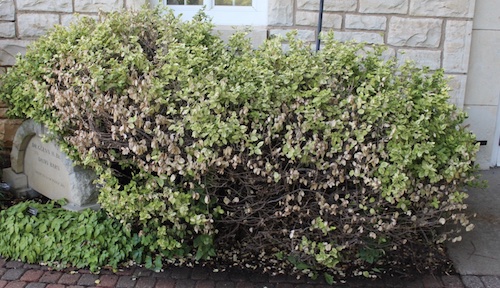
Leaf browning and defoliation damage from scale
Once you have identified the presence of scale, you must determine how you should treat it. If the plant is not too weak, or is present only in a certain area, pruning and disposing of the litter is a good option. If it regrows well and no signs of scale remain, your problem is solved. However, if there is heavy infestation, cut it almost to the ground. Then it will be easier to treat the smaller area and to monitor the regrowth. Euonymus regenerates well, so this could result in a stronger plant. If the scale is on an invasive plant, just remove and dispose of the plant. If manual removal alone is not working, or you do not want to use pesticides, you will need to remove and replace the infested plant.
With less destructive infestation, you will have to monitor and treat the plant(s) several times a year. These 2 or 3 generations of scales overlap, and suppression may take more than a year of treatment. Scales are difficult to manage because their waxy body covering shields them, so you should focus your monitoring and control efforts on the crawler stage. Combining dormant oil applications and systemic insecticides is the most effective approach. Dormant oil sprayed in late winter must cover both sides of the leaves, the branches and trunk. Tender new growth may be damaged by dormant oil, so do not apply it during the growing season. Following guidance in the PMG, apply a registered insecticide during May through June and again during July through August. Remember to prune and destroy heavily infested branches and twigs when needed.
Because scales thrive on stressed plants, promoting plant health is the best prevention. Follow recommended fertilizing and watering practices for the species. Try to improve the growing site to reduce plant stress. Do not over-fertilize as that will encourage scale buildup.
Bodies of scales remain on the plant after dying, so it can be difficult to tell if the treatment is effective. To judge, use these tips:
- Live scales produce liquid when squished; dead scales are dry.
- New foliage will have a healthier appearance once scales are no longer feeding.
- Buds should break a little earlier than when the plant was infested.
- Expanded leaves should have normal color and turgor.
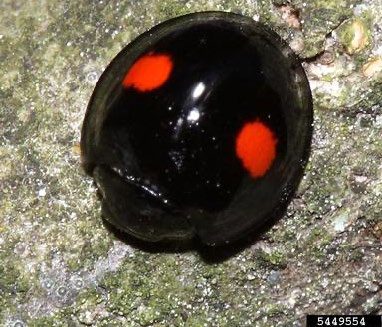
Chilocorus kuwanae Lady beetle
Pesticides are poisonous and should not be used if the lady beetle, Chilocorus kuwanae, is present. With black with two red spots on its wing covers and 3 to 4.5 mm long, it was introduced several years ago in the eastern United States specifically to help manage euonymus scale. So far, it has had only a limited impact on our pest populations.
There are no thoroughly effective controls against euonymus scale if they are on the base of the plant right at ground level, especially on vining and ground cover types of euonymus. Monitor carefully, choose the right plant for the right site and practice best horticultural practices.
- References
- Euonymus Scale, Theresa A. Dellinger and Eric Day, Virginia Cooperative Extension (444-277)
- Understanding Growing Degree Days, Pennsylvania State Extension
- Euonymus Scale, Department of Entomology, University of Kentucky
- Euonymus Scale, University of Maryland Extension
- Home Grounds & Animals 2026 Pest Management Guide, Virginia Cooperative Extension, Home Ornamentals, Table 4.6, p. 4-54